

Call us toll free: +64 226953063

Instant worldwide digital delivery — no waiting

GRASPLR Help & Support

Leverage 16: The Role of Feedback in Leverage

Sometimes a small change produces an effect that continues to grow over time.

A simple improvement in a process leads to better results, which encourages the team to repeat the behavior. Over time, the improvement spreads across the system.

In other cases, a small mistake produces ongoing problems because it keeps influencing future actions.

Both situations reveal the same underlying mechanism: feedback.
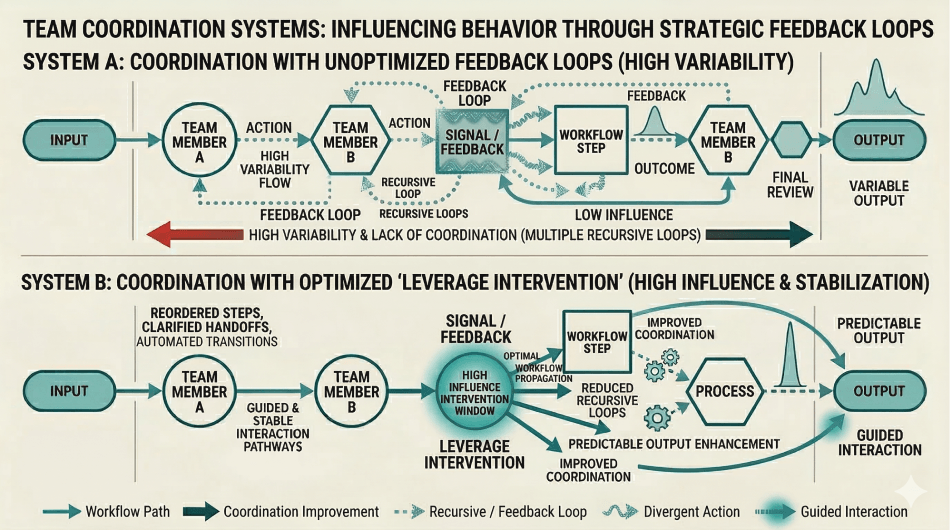
The Role of Feedback in Leverage

Systems Layer

Feedback loops are structural mechanisms that allow system outputs to influence future system behavior.

In a feedback loop, the result of an action becomes a signal that affects subsequent actions. This creates a cycle in which behavior reinforces or corrects itself over time.

There are two primary forms:

  • Reinforcing feedback loops, where an effect amplifies future activity
  • Balancing feedback loops, where an effect stabilizes or regulates behavior

Because feedback loops repeat continuously, even small interventions placed within them can scale their influence.

For example:

  • improving a measurement signal can guide better decisions repeatedly
  • clarifying a success metric can reinforce productive behaviors
  • adjusting a feedback signal can prevent errors from spreading through the system

Once the intervention becomes part of the feedback structure, the system itself continues to propagate its effect.

Structural Translation

In simple terms, feedback means that the system learns from its own results.

When the system produces an outcome, that outcome influences what happens next.

If a small improvement is placed inside this loop, the system repeats and strengthens the improvement automatically.

For example:

  • clearer performance signals help people adjust their work more quickly
  • visible progress encourages continued productive behavior
  • early error detection prevents problems from growing larger

Because the feedback loop repeats over time, the effect of the initial change multiplies.

Structural Implication

When feedback signals are weak, delayed, or missing, systems struggle to improve.

People may continue repeating ineffective behaviors because they cannot clearly see the outcome of their actions.

This can lead to:

  • slow learning cycles
  • persistent errors
  • delayed course correction
  • inconsistent performance

Without effective feedback loops, small improvements fail to propagate through the system.

Leverage Insight

Feedback loops are amplification mechanisms within systems.

AtomIQ identifies how small structural adjustments inside these loops can scale their influence across time and repeated activity.

Instant Digital Access

Secure download link delivered immediately after purchase

Built for Creators

Systems designed to help you build, not just download.

Global Compatibility

Files and toolkits accessible worldwide, no restrictions