
Many teams reach a point where the work simply stops fitting inside the time and attention available. Tasks pile up. Small jobs take longer than expected. People feel constantly busy, yet progress slows.
At first the problem appears to be productivity. The natural reaction is to work harder, reorganize tasks, or improve personal efficiency.
But often the issue is not effort at all. It is where the work lives within the system.
Systems Layer
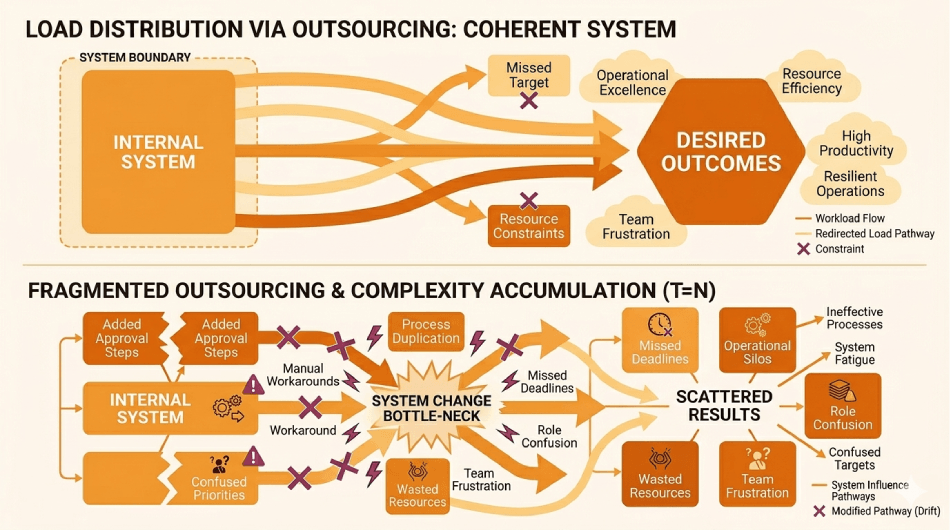
In system terms, outsourcing is a load distribution decision.
Every system contains processing capacity and operational load. The load consists of tasks, responsibilities, and decision requirements that must be processed for the system to function.

When load exceeds internal processing capacity, the system experiences strain. Signals begin to appear: delays, decision fatigue, inconsistent outputs, and rising coordination friction.
Outsourcing introduces external processing nodes into the system.
These nodes take on defined responsibilities, allowing portions of operational load to move outside the original system boundary while remaining connected through defined interfaces.
The structural purpose of outsourcing is therefore not simply labor replacement.
It is load redistribution across system boundaries.
Structural Translation
In simple terms, outsourcing is about deciding where work should live.
Instead of trying to fit everything inside one team or one person’s capacity, part of the workload is moved to another place that can process it.
That outside provider becomes another part of the system. Work flows to them, they process it, and the results flow back.
When designed properly, this reduces pressure on the internal system while keeping the work moving.
Outsourcing works best when the work being transferred has clear inputs, clear outputs, and stable expectations.
Structural Implication
When outsourcing is treated only as a cost decision, the system structure is often ignored.
Work may be transferred without defining interfaces, expectations, or coordination mechanisms. In these cases the internal system still carries the cognitive load of monitoring, correcting, and reinterpreting outputs.
Instead of reducing load, outsourcing simply moves operational tasks while leaving decision complexity inside the system.
This creates a common pattern: organizations outsource work but still feel overloaded.
The load has not actually been redistributed—only relocated.
Leverage Insight
Outsourcing becomes powerful when viewed through the pillar of Load Distribution.
The question shifts from:
“Who should do this work?”
to:
“Where in the system should this load live?”
Structural clarity about load placement allows systems to scale without overloading their internal capacity.