

In many organizations, the people with the most responsibility often become the most overloaded.
Leaders approve decisions, review work, answer questions, solve problems, and manage coordination across teams. Over time, more and more tasks begin flowing toward them simply because they have the most context.
At first this feels efficient. Important decisions stay close to the people who understand the system best.
But eventually the system begins to slow down—not because the work is difficult, but because everything must pass through the same few roles.
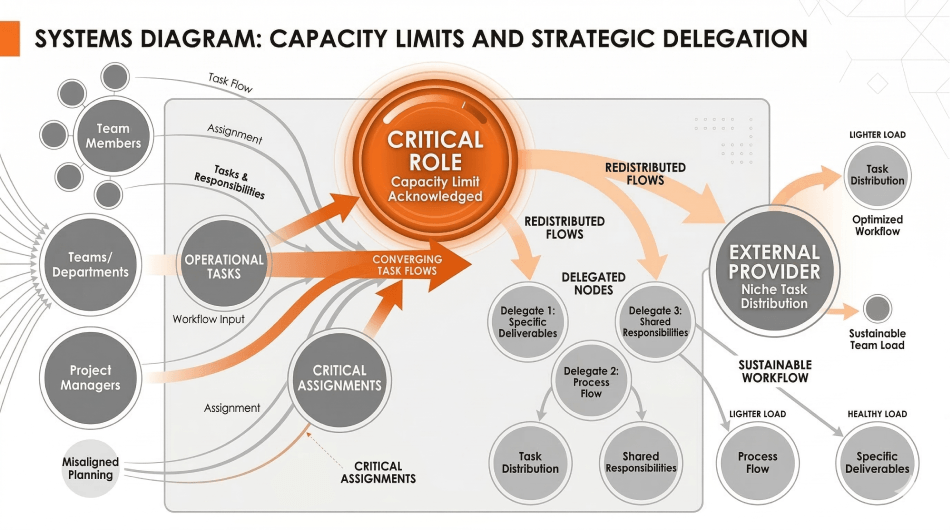
Systems Layer
Every system operates under capacity limits.
Each node—whether a person, team, or process—has a finite ability to process tasks, decisions, and signals. This capacity is constrained by time, attention, and cognitive bandwidth.

When high-dependency roles accumulate too many operational responsibilities, the system begins to approach a capacity threshold.
Beyond this threshold, system behavior changes.
Decision latency increases. Work queues grow. Coordination delays begin appearing across connected parts of the system.
Delegation and outsourcing function as capacity protection mechanisms.
By redistributing operational load to other nodes—either internal or external—the system preserves the processing capacity of critical roles that must remain focused on high-impact decisions and structural coordination.
Structural Translation
In simple terms, some roles in a system need space to think and decide.
If those roles become filled with routine tasks, approvals, and operational details, their capacity disappears.
Delegation and outsourcing help by moving certain types of work somewhere else—either to another person, another team, or an external provider.
This keeps the most critical roles from becoming overwhelmed with work that does not require their level of involvement.
Structural Implication
When capacity limits are ignored, systems unintentionally turn their most important roles into operational bottlenecks.
Leaders become approval centers. Specialists become permanent problem-solvers. Experienced team members become the place where unresolved work accumulates.
The system then begins to scale around those individuals’ capacity.
Growth slows because every additional task competes for the same limited processing bandwidth.
Delegation and outsourcing are not merely about efficiency—they are about protecting the system’s decision capacity.
Without that protection, systems gradually lose their ability to coordinate effectively.
Leverage Insight
Within the Outsourcing and Load Distribution pillar, the goal is not simply to remove work.
The goal is to protect the capacity of critical nodes so the system can continue making decisions, coordinating activity, and adapting to change.
When capacity is protected, the system maintains its ability to operate and evolve.

