

Many teams eventually decide to delegate or outsource work to relieve pressure.
Tasks are handed off. External partners are hired. Responsibilities are moved away from overloaded individuals.
At first, this seems like the solution to the workload problem.
But sometimes the opposite happens. The work returns repeatedly for corrections. Questions multiply. The original team spends more time explaining, reviewing, and fixing than they did doing the work themselves.
The delegation technically happened—but the load never truly left.
Systems Layer
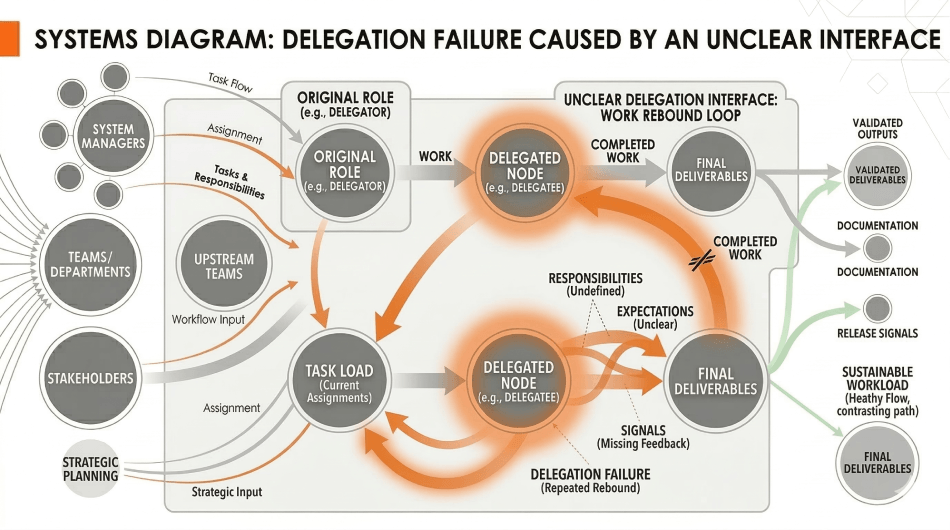
Delegation and outsourcing function as load transfer mechanisms within a system.
For load transfer to succeed, three structural elements must be defined:

- Responsibilities — what the receiving node is accountable for processing
- Expectations — the conditions that define successful output
- Signals — the information that allows the node to process the work correctly
These elements together form the interface between system nodes.
When the interface is clear, work can move across system boundaries with minimal friction.
When the interface is unclear, the receiving node lacks the structural information needed to process the load independently. Signals become incomplete, expectations remain ambiguous, and responsibilities blur.
The result is load rebound.
Work that was transferred begins returning to the original node for clarification, correction, or decision-making.
Structural Translation
In simple terms, delegation fails when people are asked to do work without knowing exactly what success looks like.
If instructions are vague, expectations unclear, or decision boundaries undefined, the person receiving the work cannot process it independently.
So they ask questions.
Or they complete the task in a way that doesn’t match expectations.
Then the original person has to step back in to fix it.
The work has technically been delegated, but the thinking load never left.
Structural Implication
When delegation repeatedly fails, organizations often conclude that certain people are simply “better at the work.”
In reality, the system may lack a functional delegation interface.
Without clear responsibilities, expectations, and signals, every outsourced task remains partially dependent on the original node.
This creates a hidden pattern where the system appears to distribute work but continues to centralize decision-making and cognitive load.
Over time, this pattern discourages further delegation because it appears inefficient.
The real issue, however, is not the people involved—it is the missing structure around the work transfer.
Leverage Insight
Within the Outsourcing and Load Distribution pillar, delegation only works when the system defines a clear interface for load transfer.
Work must move with enough structure that the receiving node can process it without constant reattachment to the original source.
When that interface exists, outsourcing truly redistributes load rather than simply circulating it.

