

Call us toll free: +64 226953063

Instant worldwide digital delivery — no waiting

GRASPLR Help & Support

Distribution 6: The Myth of “More Hands”

When work begins to pile up, the most common solution is simple: add more people.

A new hire joins the team. A contractor is brought in. Another department gets involved. The assumption is straightforward—more hands should mean more capacity.

Yet many teams discover that the workload does not actually become easier to manage.

Instead, meetings increase, coordination becomes more complex, and the original team members spend large amounts of time explaining the work rather than doing it.
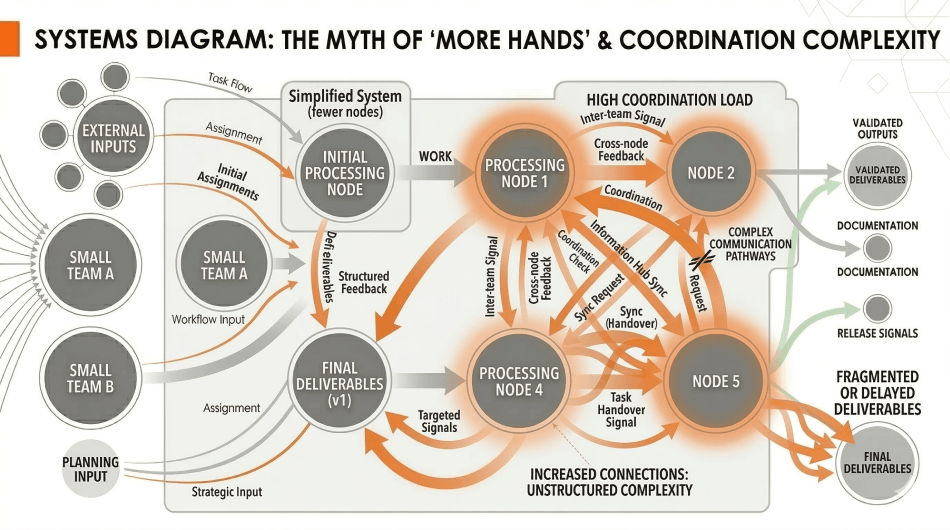
The Myth of “More Hands”

Systems Layer

Adding people increases the number of processing nodes within a system.

However, system performance is determined not only by node count but also by coordination structure.

Every additional node introduces new communication pathways. Information must move between nodes, responsibilities must be synchronized, and outputs from one node must align with inputs for another.

As node count increases, the system’s coordination load grows rapidly.

If the system lacks clear role boundaries, defined interfaces, and stable task flows, the added nodes simply introduce more coordination requirements.

In these conditions, system behavior does not improve with additional capacity.

Instead, the system becomes coordination-heavy, where increasing time is spent managing interactions between nodes rather than processing the work itself.

Structural Translation

In simple terms, adding more people only helps if the system already knows how work should move between them.

If the process is unclear, new people cannot simply start producing results.

They need context. They need direction. They need someone to explain how things work.

This means the existing team must spend time coordinating the new contributors, which can temporarily increase the workload rather than reduce it.

Without a clear structure, more people can actually slow the system down.

Structural Implication

Organizations often respond to overload by expanding the team before fixing the underlying system.

As a result, the original structural problems remain.

Work still flows through the same decision bottlenecks. Responsibilities remain ambiguous. Processes remain undefined.

The system simply becomes larger while retaining the same constraints.

This produces a familiar pattern: teams grow, but efficiency does not improve proportionally.

The issue is not the number of people involved—it is the structure that organizes their work.

Leverage Insight

Within the Outsourcing and Load Distribution pillar, adding capacity only works when the system already supports clear load routing between nodes.

When the structure is clear, additional contributors expand capacity.

When the structure is unclear, additional contributors expand coordination load.

System performance improves through structural clarity first, and capacity expansion second.

Instant Digital Access

Secure download link delivered immediately after purchase

Built for Creators

Systems designed to help you build, not just download.

Global Compatibility

Files and toolkits accessible worldwide, no restrictions