

Call us toll free: +64 226953063

Instant worldwide digital delivery — no waiting

GRASPLR Help & Support

Distribution 7: Supervisory Load in Outsourcing

Outsourcing is often introduced with a simple expectation: if someone else is doing the work, the internal team should have less to manage.

But in many cases, the opposite occurs.

Instead of performing the tasks themselves, internal teams now spend their time reviewing outputs, answering questions, clarifying instructions, and coordinating with external contributors. The work may be happening elsewhere, but the mental effort required to manage it seems to increase.

The system has distributed the tasks—but it may have concentrated the supervision.
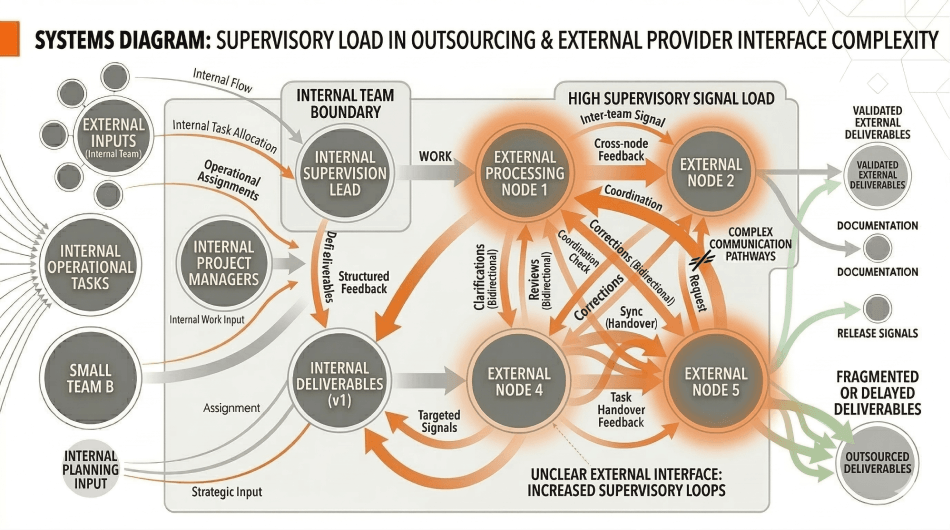
Supervisory Load in Outsourcing

Systems Layer

Outsourcing introduces additional processing nodes outside the original system boundary.

While these nodes absorb operational load, they also require coordination signals to function correctly. Work must be defined, instructions transmitted, outputs evaluated, and adjustments communicated.

This creates a new form of system demand: supervisory load.

Supervisory load consists of monitoring, clarification, evaluation, and coordination activities required to maintain alignment between internal and external nodes.

When outsourcing interfaces are well-designed—clear responsibilities, stable expectations, and consistent signals—supervisory load remains low.

However, when these structural elements are unclear, supervisory load expands rapidly.

Internal roles must continuously intervene to interpret requirements, correct misunderstandings, and reconcile mismatched outputs.

The system may distribute execution, but it centralizes cognitive coordination.

Structural Translation

In simple terms, outsourcing can reduce physical work while increasing mental work.

If the work being outsourced is not clearly defined, someone inside the system must constantly manage it.

They answer questions. They review results. They explain what should have happened.

Instead of doing the task directly, they spend their time supervising the task indirectly.

If this supervision becomes constant, the system has not actually reduced workload—it has simply changed its form.

Structural Implication

When supervisory load grows too large, the benefits of outsourcing begin to disappear.

Internal team members become full-time coordinators. Communication loops multiply. Small tasks require multiple clarifications before completion.

This pattern is often misinterpreted as a performance problem with external providers.

In many cases, however, the root issue lies in system design.

The outsourcing interface lacks clear signals, expectations, and responsibility boundaries, forcing the internal system to maintain continuous oversight.

Instead of redistributing load, the system has created a supervision-heavy structure.

Leverage Insight

Within the Outsourcing and Load Distribution pillar, successful outsourcing reduces both execution load and supervisory load.

The goal is not merely to move tasks outward.

It is to design a system where external nodes can process work with minimal ongoing intervention from the internal system.

When the structure is clear, supervision becomes occasional guidance rather than constant cognitive effort.

Instant Digital Access

Secure download link delivered immediately after purchase

Built for Creators

Systems designed to help you build, not just download.

Global Compatibility

Files and toolkits accessible worldwide, no restrictions