

Call us toll free: +64 226953063

Instant worldwide digital delivery — no waiting

GRASPLR Help & Support

Distribution 8: Signal Integrity Across Teams

When work moves between teams, most problems appear to be communication issues.

Instructions seem clear when they are sent, but the results that come back do not match expectations. Questions appear late in the process. Corrections become necessary after the work has already moved forward.

Both sides may believe they communicated properly, yet the system continues producing misalignment.

Often the issue is not how often teams communicate—but how clearly the signals move through the system.
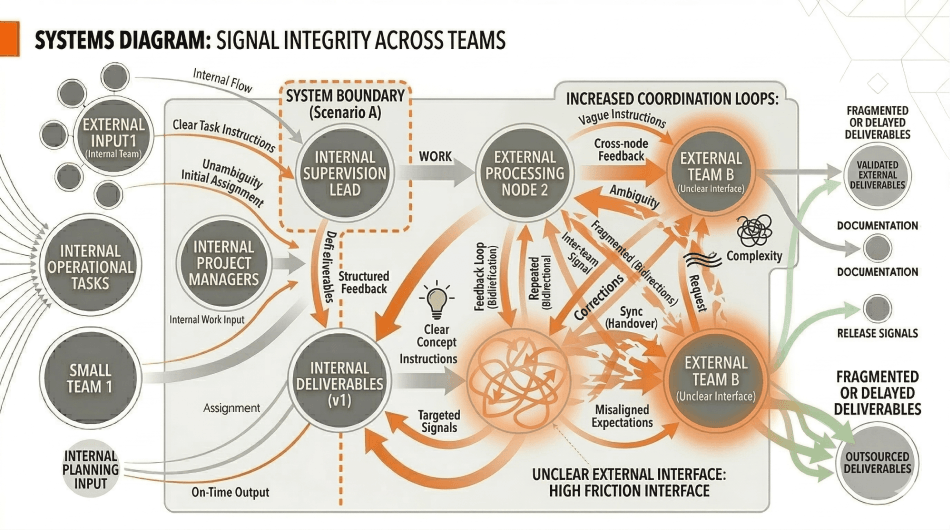
Signal Integrity Across Teams

Systems Layer

In systems terms, coordination depends on signal integrity.

Signals are the pieces of information that guide system behavior—requirements, instructions, priorities, constraints, and feedback.

When work is distributed across teams or external providers, these signals must travel across system boundaries. Each boundary introduces the potential for signal degradation.

Signal degradation occurs when information becomes incomplete, ambiguous, delayed, or distorted during transmission.

When signal integrity is high, external nodes can process tasks independently because the information they receive accurately represents system requirements.

When signal integrity is low, nodes must compensate through clarification requests, reinterpretation, or trial-and-error execution.

The result is increased coordination loops and unstable system behavior.

Structural Translation

In simple terms, distributed work only functions well when everyone receives the same clear understanding of what needs to happen.

If instructions are vague, incomplete, or inconsistent, different teams will interpret the work in different ways.

They may produce something logical based on the information they received—but that output may not match what the system actually needed.

So the work must be revised, corrected, or redone.

The real problem is not effort or competence. It is that the signal guiding the work was unclear.

Structural Implication

When signal integrity is low, outsourcing weakens the system rather than strengthening it.

External contributors become dependent on continuous clarification. Internal teams must repeatedly correct outputs or reinterpret requirements.

Work moves forward, but only through repeated feedback cycles.

Over time, this creates a perception that distributed work is unreliable.

However, the deeper structural issue is that the system cannot reliably transmit the information needed for independent execution.

The system lacks stable communication signals across its boundaries.

Leverage Insight

Within the Outsourcing and Load Distribution pillar, outsourcing succeeds when signals move cleanly across system boundaries.

The goal is not simply to pass tasks between teams.

The goal is to maintain signal integrity, so that every node in the system can process work using the same structural understanding of what the system requires.

Instant Digital Access

Secure download link delivered immediately after purchase

Built for Creators

Systems designed to help you build, not just download.

Global Compatibility

Files and toolkits accessible worldwide, no restrictions