
In many teams, work becomes distributed long before responsibility becomes clear.
Tasks are delegated. Colleagues contribute pieces of the work. External providers handle specific steps in the process.
But when something goes wrong, a familiar question appears: Who actually owns this?
The answer is often unclear. Multiple people were involved, yet no single role was clearly responsible for the final outcome.
The system distributed the work—but it also blurred the ownership.
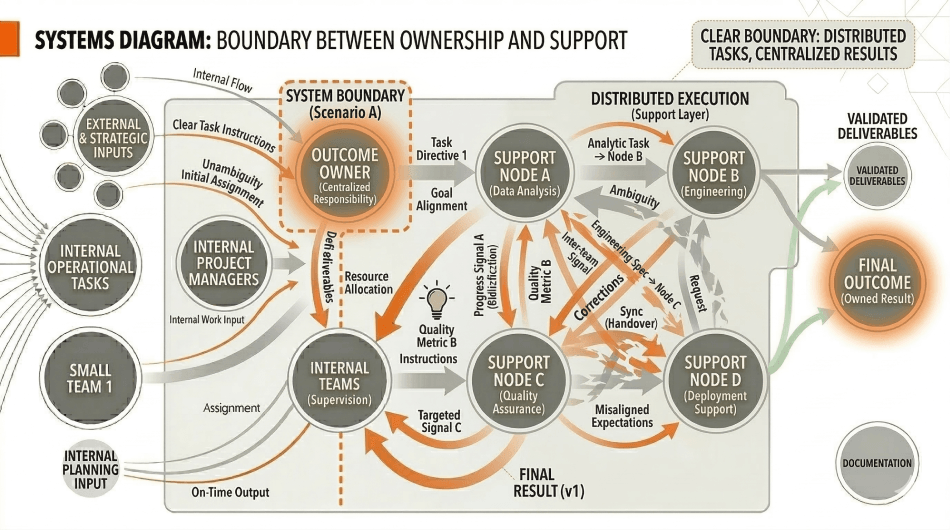
Systems Layer
In system design, there is a structural difference between task execution and outcome ownership.
Execution refers to the activities required to produce work. Ownership refers to the responsibility for ensuring that the system produces the correct outcome.

When systems distribute tasks across multiple nodes, execution becomes decentralized. However, outcome ownership must remain structurally defined.
Ownership functions as a stability anchor in the system.
It defines the node responsible for monitoring signals, resolving ambiguities, and ensuring that distributed activities converge toward the intended result.
Support nodes contribute processing capacity, but they do not replace the ownership function.
When ownership is unclear, the system loses its coordination center. Signals scatter across multiple nodes, and no role maintains responsibility for alignment.
Structural Translation
In simple terms, many people can help complete the work, but someone must still own the result.
Ownership means one role is responsible for making sure the outcome is correct—even if many others contributed along the way.
Support roles can perform tasks, provide expertise, or handle specific steps.
But they are supporting the process, not owning the outcome.
When that distinction is clear, distributed work can move smoothly.
When it is unclear, teams begin assuming that someone else is responsible.
Structural Implication
When systems blur the boundary between ownership and support, coordination becomes unstable.
Problems remain unresolved because no role has the authority to finalize decisions. Work may move forward in fragments without anyone confirming that the final outcome meets the system’s needs.
In distributed environments, this ambiguity multiplies.
Teams may believe they are collaborating effectively while the system slowly loses accountability for results.
Over time, outcomes degrade—not because individuals are incapable, but because the system no longer maintains clear ownership signals.
Leverage Insight
Within the Outsourcing and Load Distribution pillar, distributing tasks should expand capacity without dissolving accountability.
Systems perform best when execution is distributed but ownership remains structurally anchored.
This boundary allows work to move across many nodes while keeping outcomes aligned with the system’s purpose.