
When teams begin distributing work, the intention is usually simple: reduce pressure and keep things moving.
Tasks are handed off to colleagues, contractors, or external partners. Responsibility appears to shift away from the original role.
But when problems arise, confusion quickly follows. Someone assumed the task had been handled. Someone else assumed the responsibility had moved with it.
The work was passed along—but accountability quietly disappeared.
Systems Layer
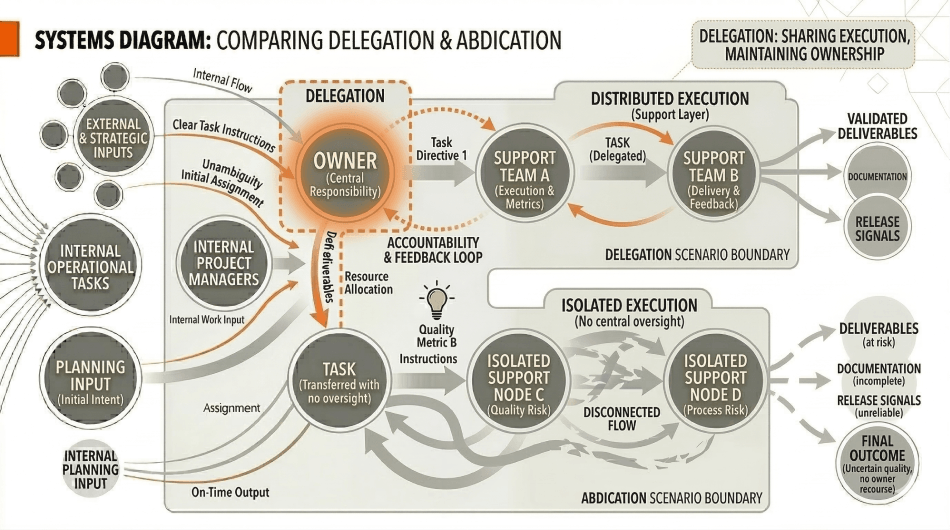
In system terms, delegation and abdication represent two different structural behaviors.
Delegation is a task transfer mechanism. Execution of specific activities moves from one node in the system to another.

However, the original node retains structural accountability for the outcome. It continues to monitor signals, evaluate outputs, and ensure alignment with system goals.
Abdication, by contrast, occurs when both execution and accountability are transferred without maintaining a coordinating node.
In this case, the system loses its structural reference point for the work. Signals about progress, quality, and completion become fragmented because no node remains responsible for maintaining alignment.
Delegation preserves the system’s accountability structure.
Abdication dissolves it.
Structural Translation
In simple terms, delegation means someone else does the work, but you still own the result.
You assign the task, provide the necessary information, and review the outcome to ensure it meets expectations.
Abdication happens when the task is handed off and the original role stops paying attention to the result.
The work may still be completed—but the system no longer has a clear point of accountability if something goes wrong.
Structural Implication
When delegation becomes abdication, distributed systems begin to drift.
Tasks may be completed, but outputs gradually diverge from the system’s needs because no role is actively maintaining alignment.
Teams assume responsibility lies elsewhere. External providers interpret requirements independently. Problems remain unresolved because no node is clearly responsible for addressing them.
Over time, this creates a pattern where work is technically distributed, yet the system struggles to produce reliable outcomes.
The missing element is not effort—it is structural accountability.
Leverage Insight
Within the Outsourcing and Load Distribution pillar, effective outsourcing transfers execution load while preserving accountability signals.
Delegation expands system capacity.
Abdication removes the structure that keeps distributed work aligned with the system’s purpose.