

Most systems try to avoid duplicated effort.
Teams are encouraged to divide responsibilities clearly so that each task belongs to one person or one group. Efficiency appears to improve when overlap disappears.
Yet in distributed environments—especially when work involves multiple teams or external partners—some overlap often appears naturally.
Two people check the same result. Another team verifies a step that someone else already completed. At first this may seem inefficient, but in many cases it quietly prevents larger failures.
Systems Layer
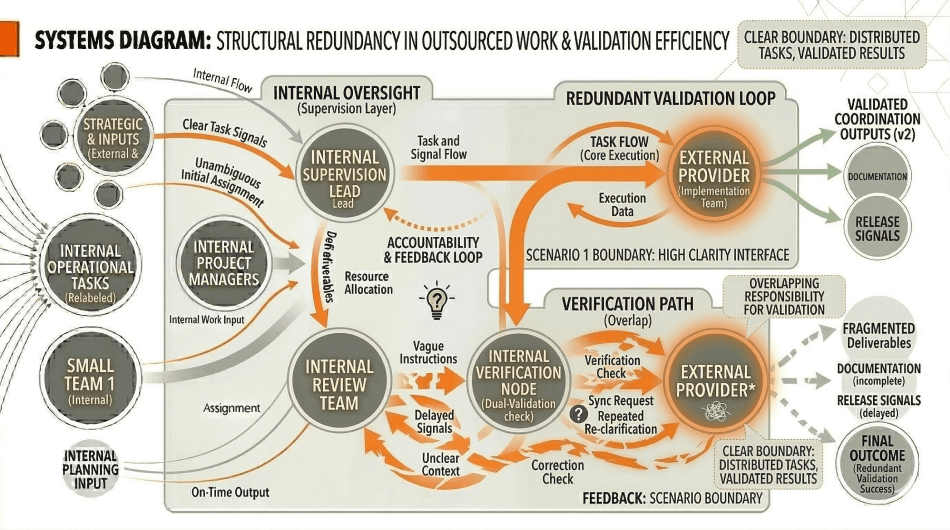
Distributed systems operate across multiple nodes connected through information signals and task flows.
Because these nodes may sit across different teams, organizations, or processes, the system becomes exposed to signal degradation, delays, or processing errors.

Structural redundancy introduces overlapping capabilities or responsibilities within the system.
Rather than relying on a single node to process a critical task or validate an output, the system allows multiple nodes to observe, verify, or process portions of the same signal.
This creates a stabilizing property.
If one node misinterprets a signal or produces an incorrect output, another node in the system can detect the discrepancy and correct it before the error propagates further.
In this way, redundancy functions as a buffer against information loss and processing errors in distributed environments.
Structural Translation
In simple terms, sometimes having more than one set of eyes on something protects the system.
If a task depends entirely on one person or one team, any mistake can move forward unnoticed.
But if another role also reviews, confirms, or cross-checks the output, problems are more likely to be caught early.
This small overlap may look inefficient in isolation, but it can prevent much larger disruptions later.
Structural Implication
When systems eliminate all overlap in the name of efficiency, they often become fragile.
Errors pass through unnoticed because no secondary check exists. External providers may misinterpret requirements without anyone inside the system recognizing the issue until much later in the workflow.
In distributed environments where signals cross boundaries and coordination is imperfect, the absence of redundancy increases system vulnerability.
Thoughtfully designed redundancy does not mean duplicating all work.
It means ensuring that critical signals and outcomes have more than one point of verification.
Leverage Insight
Within the Outsourcing and Load Distribution pillar, carefully placed redundancy can strengthen distributed systems.
While excessive duplication wastes capacity, targeted overlap around critical signals and outputs creates resilience, allowing the system to detect and correct problems before they propagate.

