

Call us toll free: +64 226953063

Instant worldwide digital delivery — no waiting

GRASPLR Help & Support

Distribution 13: The Risk of Fragmented Responsibility

In many organizations, work is shared across many contributors.

One person gathers information. Another performs analysis. A third team implements the solution. External partners may handle specialized components.

From a distance, the system appears collaborative.

But when the final outcome does not meet expectations, a familiar situation emerges: everyone contributed to the work, yet no single role feels fully responsible for the result.

The system completed many tasks, but accountability was scattered.
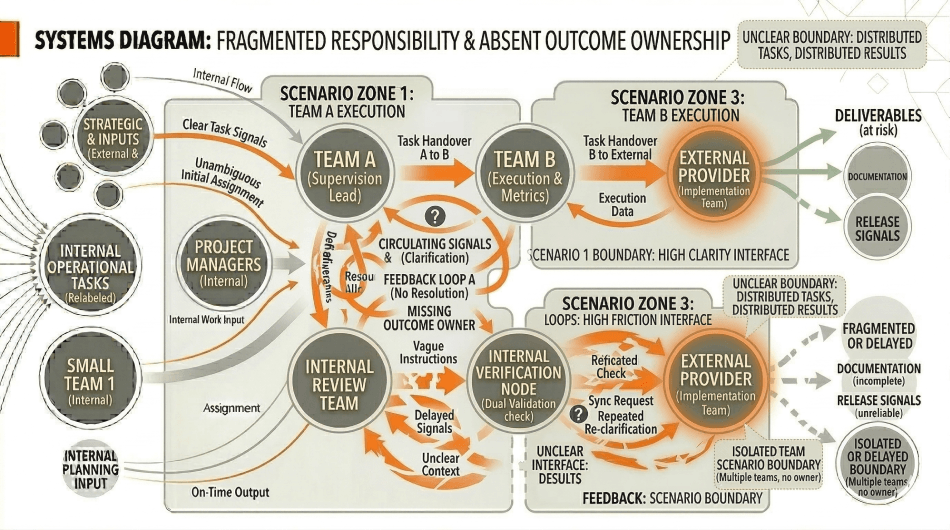
The Risk of Fragmented Responsibility

Systems Layer

In system design, responsibility must anchor outcomes.

Distributed systems rely on multiple nodes to process tasks, but successful system behavior requires at least one node to maintain outcome responsibility.

Outcome responsibility means monitoring signals across the workflow, resolving ambiguities, and ensuring that distributed activities converge toward the intended result.

When systems distribute tasks without maintaining a clear ownership node, responsibility becomes fragmented.

Each node performs its local function but assumes that alignment is maintained elsewhere in the system.

Without an ownership anchor, signals about quality, completion, and correction lack a clear destination. Issues move through the system without being resolved because no role holds structural authority to address them.

The system continues operating, but its outputs gradually lose coherence.

Structural Translation

In simple terms, when many people contribute to a process, someone still needs to own the final outcome.

Without that ownership, each person focuses only on their portion of the work.

If something goes wrong, it becomes unclear who should fix it.

The system becomes a chain of partial responsibilities where everyone completes their step, but no one is responsible for making sure the entire result works.

Structural Implication

Fragmented responsibility creates systems that appear active but struggle to produce reliable outcomes.

Tasks are completed, but alignment problems persist because no role has the authority or responsibility to correct them.

This often leads to prolonged discussions about who should handle issues rather than immediate resolution.

In outsourced or distributed environments, the risk becomes even greater.

External providers may assume internal teams hold final responsibility, while internal teams assume the provider controls execution.

The result is a structural gap where ownership signals disappear.

Leverage Insight

Within the Outsourcing and Load Distribution pillar, distributing tasks must never eliminate outcome ownership.

Systems remain stable when work can move across many nodes while responsibility remains anchored to a clearly defined role.

Without that anchor, distributed work becomes fragmented rather than coordinated.

Diagram Prompt

0413 Create a clean systems diagram illustrating fragmented responsibility. Show multiple nodes labeled Team A, Team B, and External Provider each performing tasks in sequence. Illustrate that no node holds the role of Outcome Owner, resulting in signals about quality or correction circulating without resolution. Include arrows showing task flow but broken or looping feedback signals. Use a minimal, professional systems-thinking style. Landscape Ratio, blue style

Post Image Prompt

Create a conceptual illustration representing fragmented responsibility. Show several workers each holding a piece of a large structure, but no one holding the central connecting piece that holds the structure together. The structure begins to drift apart because no single point stabilizes it. Use a clean modern editorial style with simple shapes and a neutral background to symbolize scattered accountability. Landscape Ratio, blue style

Instant Digital Access

Secure download link delivered immediately after purchase

Built for Creators

Systems designed to help you build, not just download.

Global Compatibility

Files and toolkits accessible worldwide, no restrictions