

Call us toll free: +64 226953063

Instant worldwide digital delivery — no waiting

GRASPLR Help & Support

Distribution 14: Capacity Protection for Decision Makers

In many organizations, the most experienced people eventually become the most interrupted.

Questions flow toward them. Decisions wait for their approval. Complex problems are routed in their direction because they understand the system better than anyone else.

Over time, these roles become filled with operational details—small tasks, clarifications, and routine decisions that gradually consume their attention.

The people responsible for the system’s most important thinking begin spending most of their time reacting to day-to-day work.
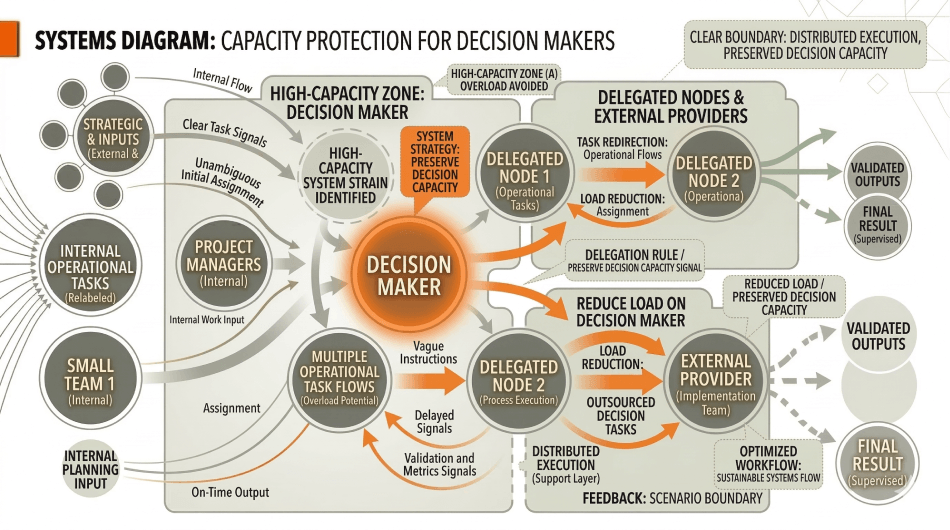
Capacity Protection for Decision Makers

Systems Layer

Within a system, some nodes carry decision-critical functions.

These nodes—often leaders, specialists, or senior operators—perform high-leverage activities such as strategy formation, complex problem resolution, and structural coordination.

Because these activities rely on deep attention and contextual understanding, their processing capacity is limited and cognitively intensive.

When operational load accumulates around these nodes, the system experiences capacity erosion.

Routine tasks, status questions, and minor approvals begin consuming the same cognitive resources required for higher-order decision making.

Outsourcing and delegation function as capacity protection mechanisms.

By relocating operational tasks to other nodes—either internal roles or external providers—the system shields critical nodes from routine load and preserves their ability to process complex signals and make high-impact decisions.

Structural Translation

In simple terms, some roles need mental space to think.

If those roles become buried in routine work, they lose the ability to focus on the decisions that matter most.

Outsourcing helps by moving certain tasks elsewhere so that leaders and specialists are not constantly pulled into operational details.

The work still gets done, but the people responsible for guiding the system retain the attention needed to do their jobs effectively.

Structural Implication

When systems fail to protect decision-making capacity, several patterns appear.

Leaders spend most of their time responding to small operational issues. Specialists become permanent troubleshooters instead of advancing deeper work. Strategic decisions slow because attention is fragmented across too many tasks.

The system begins operating in a reactive mode.

Even though capable decision makers exist within the structure, their cognitive bandwidth has been consumed by operational load.

Outsourcing in this context is not primarily about reducing work volume.

It is about protecting the cognitive bandwidth required for system-level thinking.

Leverage Insight

Within the Outsourcing and Load Distribution pillar, effective systems intentionally protect the processing capacity of high-leverage roles.

Operational work can move outward.

But the attention required for coordination, judgment, and adaptation must remain available within the system’s critical nodes.

Instant Digital Access

Secure download link delivered immediately after purchase

Built for Creators

Systems designed to help you build, not just download.

Global Compatibility

Files and toolkits accessible worldwide, no restrictions