
When teams first outsource work, the knowledge required to complete that work often remains in someone’s head.
Instructions are shared through quick messages, short meetings, or informal explanations. The internal team knows how things should be done because they have done the work before.
But external contributors do not have the same context.
Without a clear reference, they must repeatedly ask questions, confirm assumptions, and rely on partial explanations. Work moves forward, but each step requires additional effort to interpret what the system expects.
Systems Layer
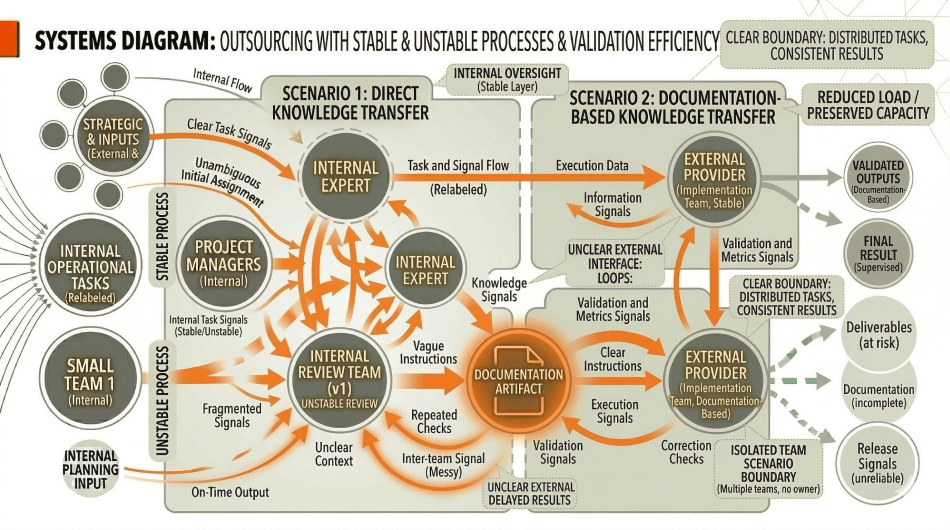
In distributed systems, knowledge functions as operational signals.
These signals guide how tasks should be processed, what constraints apply, and what outputs the system considers acceptable.

When this knowledge exists only in individual memory, the signals remain implicit.
Implicit signals require continuous transmission through conversation, clarification, and supervision. Each time the work cycle begins, the system must recreate the same guidance through human interaction.
Documentation transforms implicit signals into persistent system artifacts.
These artifacts store process steps, decision rules, expectations, and contextual information in a form that can be accessed repeatedly without requiring the original knowledge holder.
By externalizing these signals, documentation reduces the amount of cognitive effort required to transmit knowledge across system boundaries.
Structural Translation
In simple terms, documentation turns unwritten knowledge into something others can follow.
Instead of explaining the same task every time, the system provides a clear reference that shows how the work should be done.
External contributors can read the instructions, understand the process, and complete the work with less supervision.
The knowledge moves from people’s memory into the system itself.
Structural Implication
When documentation is missing, distributed systems rely heavily on individuals who understand the work.
Those individuals become constant sources of clarification. They answer repeated questions, correct misunderstandings, and guide external contributors through each step.
This creates hidden cognitive load within the system.
Even though tasks have been outsourced, the mental effort required to support those tasks remains concentrated in a few roles.
Documentation reduces this dependency by embedding operational knowledge directly into the system’s structure.
Leverage Insight
Within the Outsourcing and Load Distribution pillar, documentation functions as cognitive load distribution.
By storing operational knowledge in stable artifacts, the system allows work to move across nodes without requiring continuous mental effort from the original knowledge holders.