

Many teams believe delegation should happen naturally.
As work increases, tasks are simply handed to someone else. Another team member takes responsibility, or an external provider is asked to help. The expectation is that work will redistribute automatically.
But in practice, delegation often feels difficult.
Tasks return with questions. Outputs require extensive corrections. The original role ends up supervising every step, making the process feel more exhausting than doing the work alone.
The challenge is rarely the willingness to delegate—it is the system’s ability to support delegation.
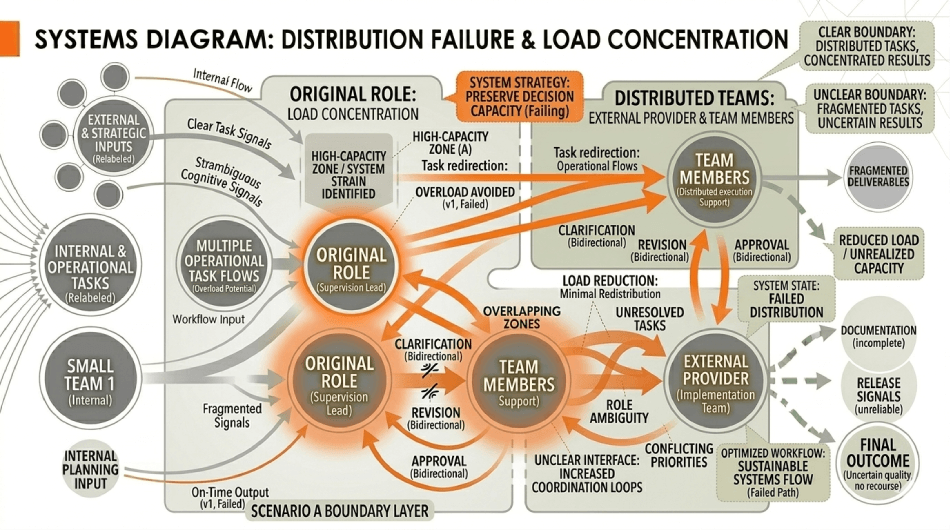
Systems Layer
Delegation depends on structural readiness.
For work to move from one node to another, the system must provide a clear processing interface between those nodes.

This interface includes several elements:
- defined responsibilities
- stable process steps
- clear input signals
- explicit output expectations
- known decision boundaries
Together, these elements allow the receiving node to process the task independently.
Without this structure, the delegated node cannot interpret the task reliably. Signals become ambiguous, steps vary between cycles, and expectations remain implicit.
As a result, the originating node must remain continuously involved, maintaining supervision and interpretation.
In this situation, the system has distributed execution but not processing autonomy.
Structural Translation
In simple terms, delegation works best when the work is clear enough that someone else can do it without constant guidance.
If a task depends on unwritten knowledge, unclear expectations, or constantly changing steps, another person cannot easily take it over.
The original role must stay involved to explain what should happen.
Designing a system for delegation means turning that hidden knowledge into clear instructions, repeatable steps, and defined responsibilities.
Structural Implication
Organizations that struggle with delegation often assume the issue lies with individuals.
They may believe team members lack initiative or capability.
However, the underlying constraint is frequently structural.
If tasks cannot be transferred cleanly between roles, people naturally avoid delegating them. Delegation appears inefficient because the system forces continuous supervision.
Intentional system design changes this dynamic.
By creating stable interfaces between roles, the system allows work to move without constant interpretation.
Leverage Insight
Within the Outsourcing and Load Distribution pillar, effective delegation is not simply a behavior—it is a system property.
When systems are intentionally structured with clear interfaces and repeatable processes, work can move across nodes without bringing the original load back with it.

