

Call us toll free: +64 226953063

Instant worldwide digital delivery — no waiting

GRASPLR Help & Support

Distribution 25: Distribution as a Structural Capability

Many organizations first approach outsourcing as a temporary solution.

Workload increases, deadlines tighten, and external support seems like a practical way to relieve pressure. Tasks are passed outward to create breathing room for the internal team.

But over time, something becomes clear.

Some organizations consistently handle growth and complexity without overwhelming their people, while others struggle even with modest increases in activity. The difference is not simply effort or talent.

It is how well the system can distribute its work.
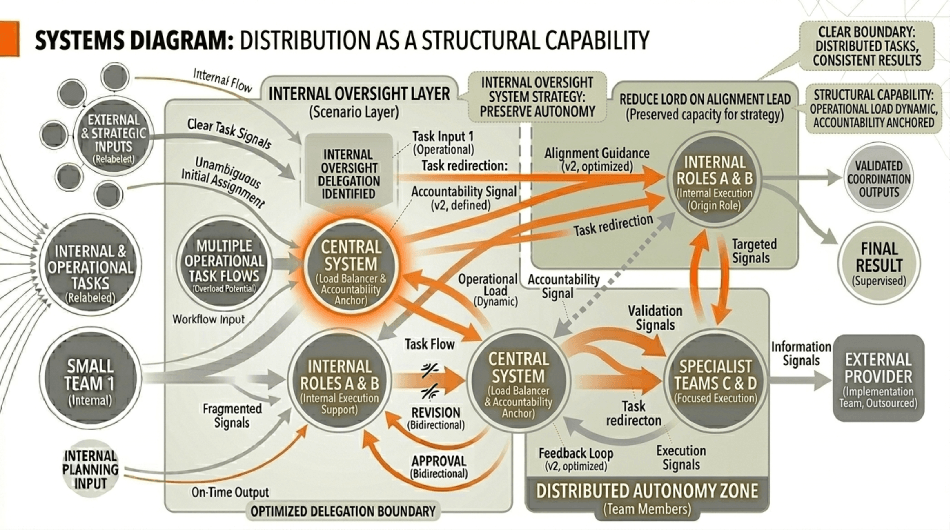
Distribution as a Structural Capability

Systems Layer

Distribution is a structural capability of a system.

A system capable of distribution can move operational load across multiple nodes—internal roles, teams, processes, and external providers—without losing coordination or control.

This capability depends on several structural elements working together:

  • clear role interfaces
  • stable processes
  • reliable information signals
  • defined accountability for outcomes

When these structures are present, work can shift between nodes as system demand changes. Load moves toward available capacity while maintaining alignment with system goals.

Without this capability, operational load accumulates in a limited number of nodes.

As demand increases, these nodes reach their processing limits, and the system experiences overload—delays, decision bottlenecks, and coordination friction.

Distribution expands the system’s effective processing capacity without requiring any single node to carry the entire load.

Structural Translation

In simple terms, strong systems are able to move work to where capacity exists.

Instead of relying on a few people to handle everything, the system spreads tasks across many roles that can process them.

This does not happen automatically.

The system must clearly define who handles which responsibilities, how work moves between roles, and how results are monitored.

When that structure exists, the system can grow without overwhelming its core participants.

Structural Implication

Organizations that lack distribution capability often rely on individual heroics to keep work moving.

Key people absorb excess load, make rapid decisions, and compensate for unclear structures.

This approach can work temporarily, but it does not scale.

As the system grows, the same individuals become bottlenecks, and the organization begins operating at the limits of human capacity.

Systems designed for distribution behave differently.

Work moves fluidly across roles and partners, allowing complexity to increase while keeping individual cognitive load manageable.

Leverage Insight

Within the Outsourcing and Load Distribution pillar, outsourcing is not merely a tactic for handling extra work.

It is a core structural capability that allows systems to expand their capacity, adapt to changing demand, and scale without overwhelming the people inside them.

Instant Digital Access

Secure download link delivered immediately after purchase

Built for Creators

Systems designed to help you build, not just download.

Global Compatibility

Files and toolkits accessible worldwide, no restrictions