

Call us toll free: +64 226953063

Instant worldwide digital delivery — no waiting

GRASPLR Help & Support

Structural Archetype 5: Structural Constraint and Bottleneck Model

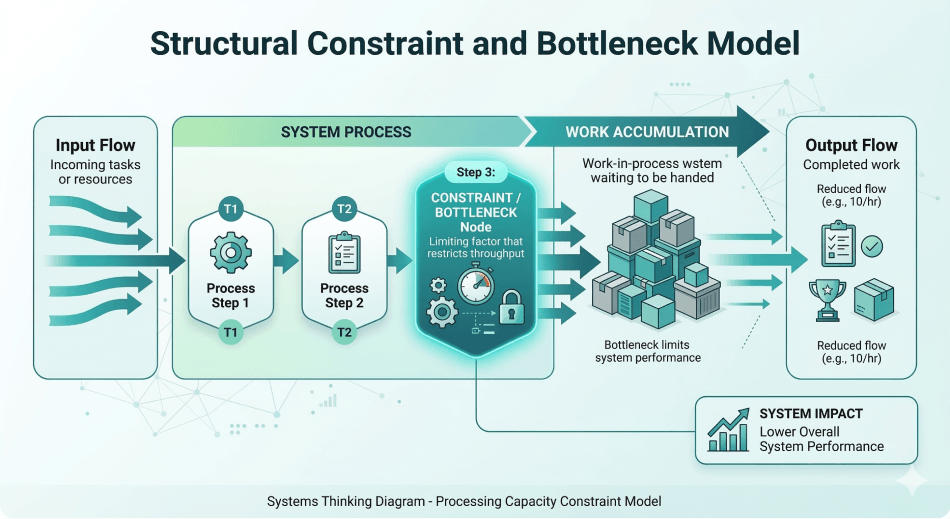
The Structural Constraint and Bottleneck Model illustrates how the performance of an entire system is often determined by a single limiting component. In many operational systems, work moves through a sequence of steps, forming a processing pipeline. Although multiple stages may exist, the throughput of the entire system is ultimately limited by the slowest or most constrained stage.

This diagram shows how incoming work flows through a series of process steps before encountering a structural constraint. When the capacity of this constraint is lower than the rate of incoming work, tasks begin to accumulate, creating queues and reducing overall system performance.

Understanding where constraints occur is essential for improving system efficiency because optimizing non-constrained parts of a system rarely increases total output.
Input Flow

The system begins with an input flow representing incoming tasks, materials, or resources entering the system.

In operational environments this may include customer requests, production materials, project assignments, or incoming data. Input flow determines how much work the system must process over time.

When input flow remains balanced with the system’s capacity, work moves smoothly through the pipeline. However, when incoming demand exceeds the capacity of any step within the system, congestion begins to appear.

System Process

After entering the system, work moves through a series of process steps. These steps represent the sequence of operations required to transform inputs into completed outputs.

Each process stage performs a specific function. In manufacturing this might include fabrication, assembly, and inspection. In information systems it may involve data collection, processing, and reporting.

Ideally, each stage in the pipeline operates at a capacity that supports the overall flow of the system. However, in practice, some stages have lower capacity than others.

Constraint or Bottleneck Node

The central element of the model is the constraint or bottleneck node.

A bottleneck occurs when one stage in the system processes work more slowly than the stages before or after it. Because work cannot pass through the bottleneck faster than its capacity allows, the entire system becomes limited by this single point.

Even if other stages operate efficiently, they cannot increase overall output beyond the capacity of the constraint.

In the diagram, this node represents the structural limitation that restricts throughput.

Work Accumulation

When incoming work arrives faster than the bottleneck can process it, tasks begin to accumulate before the constraint.

This buildup forms a queue of work-in-progress waiting to be processed. The longer the constraint remains overloaded, the larger the queue becomes.

Accumulation creates several operational challenges. Waiting times increase, coordination becomes more complex, and visibility into system status becomes more difficult.

Over time, excessive accumulation may create pressure on upstream stages, causing instability across the entire system.

Output Flow

The output flow represents completed work leaving the system.

Although multiple process stages may exist, the rate of output is ultimately determined by the bottleneck’s processing capacity. This means the entire system’s throughput is effectively capped at the speed of the constraint.

Even if upstream processes operate faster, the final output cannot exceed the bottleneck’s capacity.

This principle explains why improving non-constrained stages often produces little measurable improvement in total system output.

Structural Translation

The bottleneck model appears in many types of systems.

In manufacturing, a slow machine may limit production regardless of how efficiently other machines operate. In project management, a single decision authority may slow progress even when teams are ready to proceed.

In software systems, a database server or network connection may become the limiting factor that restricts overall performance.

In organizational systems, a constrained approval process can slow entire workflows.

In each case, the same structural rule applies: the system moves at the speed of its constraint.

Structural Implication

Organizations often attempt to improve performance by increasing activity across the entire system. Teams may work harder, additional tasks may be started, or more resources may be added to upstream stages.

However, if the bottleneck remains unchanged, these efforts typically increase work accumulation rather than improving output.

As work queues grow, system complexity increases and performance may actually decline. Participants may feel busier while the system produces little additional value.

Recognizing the location of the constraint is therefore essential for meaningful improvement.

Leverage Insight

The most effective way to increase system throughput is to improve the capacity of the bottleneck.

This may involve adding resources to the constrained stage, simplifying the work required at that step, automating tasks, or redistributing work across additional processing nodes.

Once the constraint is expanded or removed, system throughput immediately increases because the limiting factor has changed.

By focusing improvement efforts on structural constraints rather than individual activity levels, systems designers can achieve far greater gains in overall performance.

Instant Digital Access

Secure download link delivered immediately after purchase

Built for Creators

Systems designed to help you build, not just download.

Global Compatibility

Files and toolkits accessible worldwide, no restrictions