

Call us toll free: +64 226953063

Instant worldwide digital delivery — no waiting

GRASPLR Help & Support

Structural Archetype 6: Distributed Work and Coordination Model

The Distributed Work and Coordination Model illustrates how complex systems organize work across multiple roles while maintaining alignment through a central coordination function. As systems grow in scale, it becomes increasingly difficult for a single unit to perform all tasks directly. Work must instead be distributed across specialized roles or nodes.

In a distributed structure, different participants perform different parts of the overall process. Coordination becomes the mechanism that connects these roles and ensures that work flows efficiently across the system.

The diagram shows a central coordination node that distributes tasks outward to multiple roles while receiving status and result signals in return. This bidirectional flow allows the system to operate as a coordinated network rather than a collection of disconnected participants.
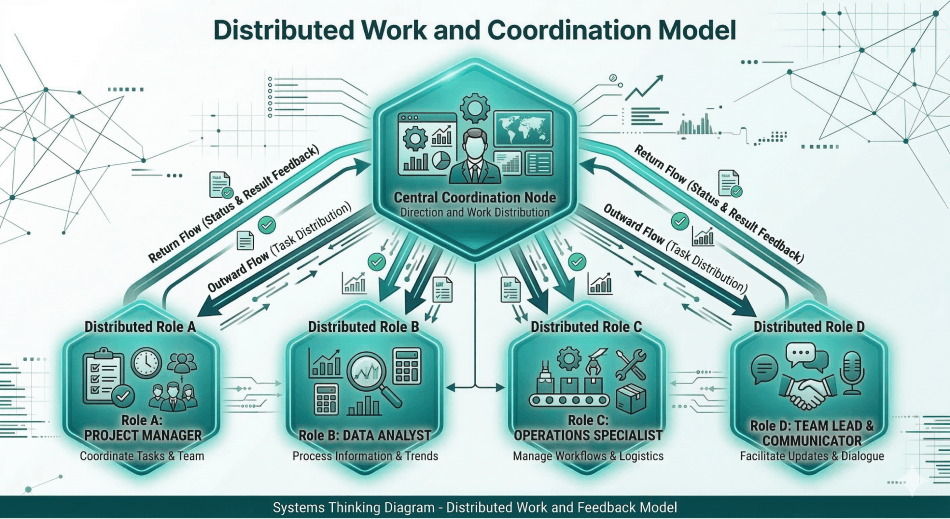
Central Coordination Node

At the center of the model is the coordination node. This node provides direction, organizes work distribution, and maintains visibility across the entire system.

The coordination node does not necessarily perform the operational work itself. Instead, it establishes priorities, allocates tasks, and ensures that activities across distributed roles remain aligned with system goals.

In organizational systems this role may be performed by leadership teams, project managers, or operational control centers. In technical systems it may be a scheduling engine, control system, or platform architecture that routes tasks to appropriate nodes.

The coordination node functions as the system’s alignment mechanism.

Outward Task Distribution

From the coordination node, tasks and instructions flow outward to distributed roles. This outward flow represents the distribution of work across the system.

Each distributed role receives assignments appropriate to its function. This allows the system to divide complex work into specialized tasks that can be handled more efficiently by dedicated participants.

Distributing work increases system capacity because multiple roles can operate simultaneously. However, this also increases the importance of coordination because tasks must remain synchronized.

Without clear distribution rules, distributed systems quickly become fragmented.

Distributed Roles

The diagram illustrates several distributed roles, each responsible for a different part of the system’s operation.

One role may coordinate project activities and team interactions. Another may analyze information and generate insights. A third may manage operational workflows or logistical processes. Another may facilitate communication and stakeholder engagement.

Although each role performs specialized tasks, their outputs are interdependent. The system only functions effectively when these roles operate within a shared structure that supports collaboration.

Distributed roles therefore form the execution layer of the system.

Return Flow and Feedback

While tasks flow outward from the coordination node, information flows back toward it.

Distributed roles provide status updates, performance signals, and results through return flow channels. These feedback signals allow the coordination node to monitor progress and adjust work distribution as needed.

Return flows are essential because they provide visibility into how the distributed system is performing. Without these signals, the coordination node cannot determine whether tasks are being completed effectively.

Feedback channels therefore form the communication backbone of distributed systems.

Coordination Loop

The combination of outward task distribution and return feedback creates a continuous coordination loop.

The coordination node sends tasks outward, distributed roles execute the work, and results flow back to the center. Based on this information, the coordination node may adjust priorities, redistribute tasks, or resolve emerging issues.

This loop allows distributed systems to operate dynamically rather than relying on rigid instructions. As conditions change, coordination adapts accordingly.

Over time, this continuous coordination cycle keeps distributed participants aligned.

Structural Translation

This model appears in many types of systems that require coordinated collaboration.

In organizations, leadership teams distribute responsibilities across departments while monitoring progress through reporting systems. In software systems, distributed computing architectures allocate tasks across multiple servers while central schedulers track performance.

Supply chains also follow this structure. A central planning function distributes production tasks to suppliers and manufacturers while receiving delivery and quality signals in return.

Wherever work is divided across multiple participants, coordination structures become necessary.

Structural Implication

Distributed systems offer powerful advantages, including scalability, specialization, and flexibility. However, they also introduce coordination complexity.

If coordination mechanisms are weak, distributed roles may become misaligned. Tasks may overlap, communication may break down, and decision-making may slow as participants attempt to resolve uncertainty.

When coordination is clear and communication channels are reliable, distributed systems can operate smoothly even across large networks of participants.

Effective coordination transforms distributed complexity into organized collaboration.

Leverage Insight

The performance of distributed systems depends heavily on the strength of their coordination structure.

Improving task clarity, strengthening communication channels, and providing reliable feedback mechanisms can significantly enhance system performance.

Rather than attempting to control every action within the system, effective coordination focuses on maintaining alignment across distributed roles.

When direction flows clearly outward and reliable signals flow back, the system can coordinate complex work across many participants while maintaining coherent performance.

Instant Digital Access

Secure download link delivered immediately after purchase

Built for Creators

Systems designed to help you build, not just download.

Global Compatibility

Files and toolkits accessible worldwide, no restrictions