

What appears as conquest, conflict, scarcity, and death is, at a deeper level, a progression of system mechanics: integration, activation, constraint, and failure. The destructive cycle is not chaotic—it is structured.
Phase I – Integration Capture (White Horse)
Economic Access Becomes Structural Control
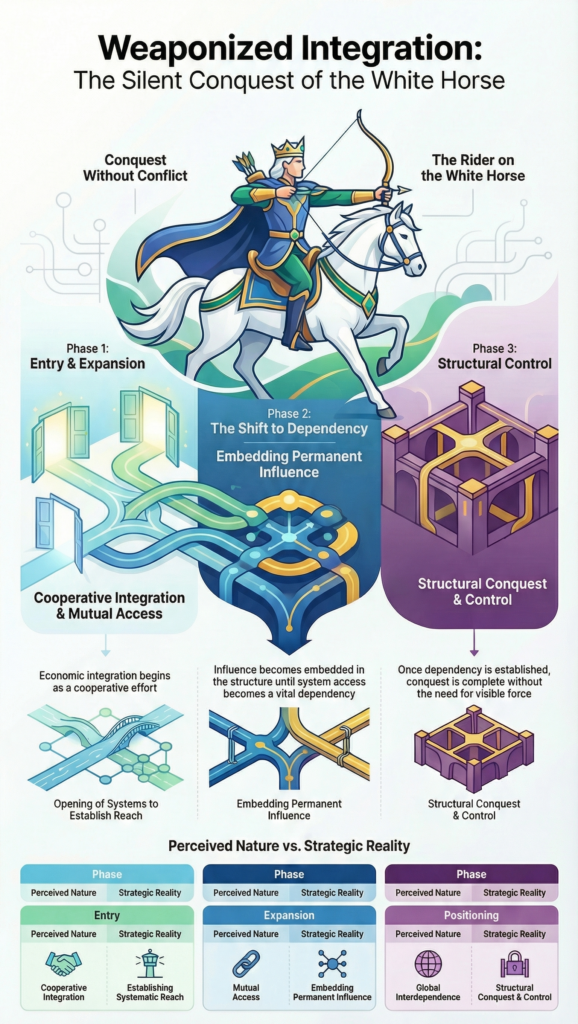
The cycle begins with openness. As shown in the image’s White Rider—crowned, composed, and advancing with precision—this phase is not about force. It is about entry.
Integration feels cooperative. Systems connect, markets expand, and participation appears mutually beneficial. But the shift occurs when access becomes dependency.
This is where Integration Capture takes hold.
Economic pathways—trade, infrastructure, finance, standards—begin as shared channels. Over time, they become embedded requirements. What was once optional becomes essential. Influence does not need to be imposed because it is already built into the structure.
- Entry establishes presence
- Expansion builds reliance
- Positioning converts reliance into leverage
Like the White Rider’s quiet authority, control is established without visible conflict. The system opens—and in doing so, becomes permeable to influence.
Phase II – Fear Vectoring (Red Horse)
Terror Becomes the Delivery Mechanism of Conflict
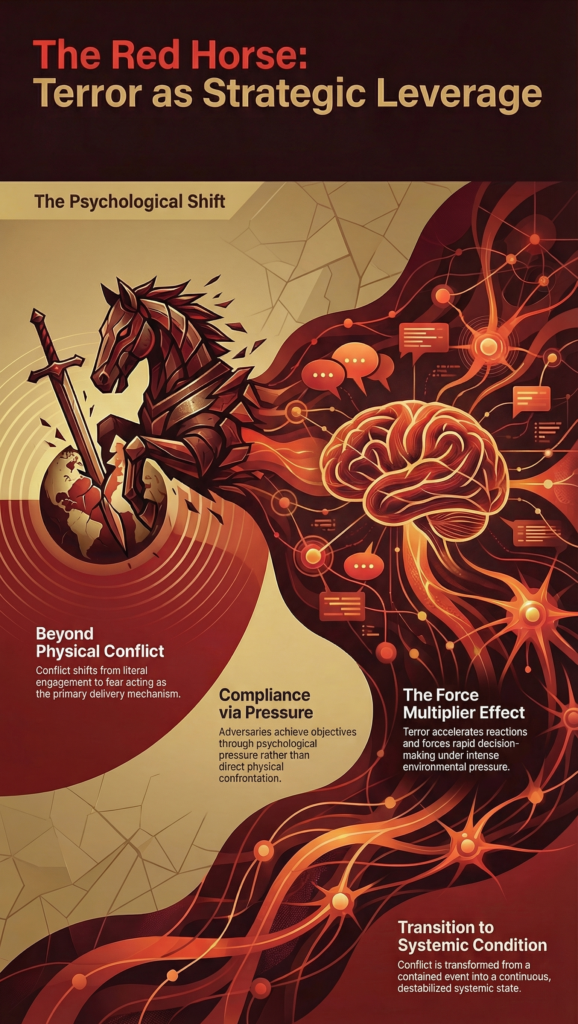
The Red Rider in the image is not subtle—flames, motion, and weapon drawn. But the true shift in this phase is not physical violence. It is psychological activation.
Conflict begins as force, but it scales through fear.
This is Fear Vectoring—where terror becomes a force multiplier.
A single disruptive act radiates outward, amplified through perception. The system does not just react to events; it begins to anticipate them. And in that anticipation, behavior changes.
- Activation introduces high-impact disruption
- Diffusion spreads fear beyond the origin point
- Conditioning reshapes decision-making under pressure
The Red Horse does not need constant engagement. Once fear is embedded, the system self-regulates around it. Stability erodes not from continuous attack, but from sustained uncertainty.
Phase III – Access Throttling (Black Horse)
Financial Systems Engineer Scarcity
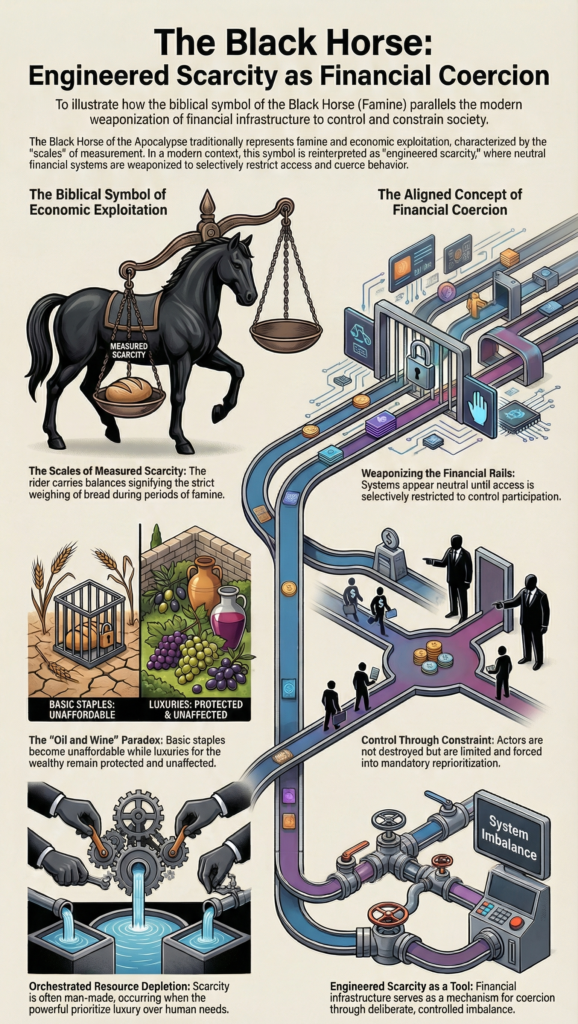
The Black Rider, holding scales in the image, represents measurement, allocation, and imbalance. This phase is not about destruction—it is about restriction.
Finance appears neutral—until access is controlled.
This is Access Throttling.
Instead of removing resources, the system limits flow. Credit tightens. transactions slow. liquidity becomes conditional. The system remains intact, but participation becomes uneven.
- Control points introduce friction into financial rails
- Scarcity forms through restricted access, not absence
- Behavior compresses under constrained optionality
This mirrors famine not as sudden deprivation, but as sustained limitation. Actors are not eliminated—they are forced to reprioritize, conserve, and adapt within narrowing constraints.
The Black Horse does not destroy the system. It constrains it until imbalance becomes the dominant condition.
Phase IV – Fragility Cascades (Pale Horse)
Supply Chains Convert Efficiency Into Collapse
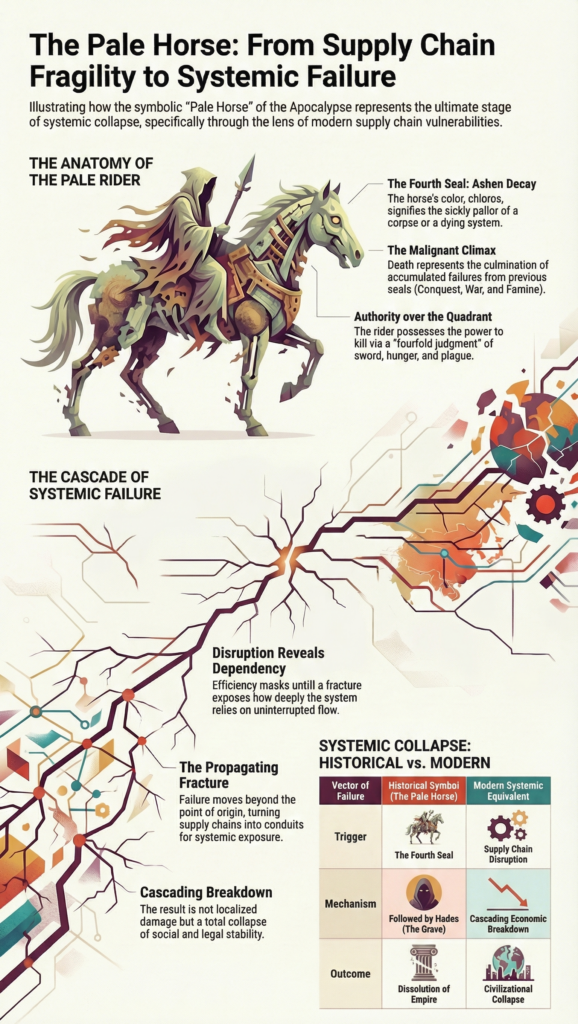
The Pale Rider, emerging from a landscape of decay, represents the final phase: exposure.
By this point, the system is fully optimized—and fully dependent.
This is where Fragility Cascades begin.
Supply chains, once symbols of efficiency, reveal their hidden cost: tight coupling without resilience. When disruption occurs, it does not stay contained. It propagates.
- A disruption point breaks continuity
- Dependency exposure reveals hidden reliance
- Cascades spread failure across interconnected nodes
The system does not collapse in a single moment. It fractures across layers, each failure triggering the next. What once enabled seamless flow now accelerates breakdown.
The Pale Horse is not the cause of collapse—it is the consequence of everything that came before.
The Cycle Is Continuous, Not Linear
What the image makes clear—and what each phase reinforces—is that this is not a sequence with a clean endpoint. Collapse feeds back into reintegration. Scarcity reshapes access. Conflict resets positioning.
Each phase transforms the system in a way that makes the next phase more likely.
- Integration creates dependency
- Dependency amplifies fear sensitivity
- Fear accelerates restrictive control
- Restriction exposes structural fragility
- Fragility leads to collapse—and reset
This is not a story of events. It is a model of behavior.
From Force to Structure to Failure
The deeper insight across all four phases is the evolution of control:
- It begins invisibly (integration)
- It scales psychologically (fear)
- It stabilizes structurally (constraint)
- It ends systemically (collapse)
At no point does control rely solely on force. Instead, it migrates—from access, to perception, to infrastructure, to architecture itself.
By the time failure becomes visible, control has already done its work.
Collapse Is Not the End—It Is the Revelation
The destructive cycle does not create fragility—it reveals it.
Each phase strips away an assumption:
- That openness is neutral
- That conflict is contained
- That systems are accessible
- That efficiency equals resilience
What remains is a clearer view of how systems actually function under pressure.
And once that structure is visible, the cycle is no longer just something to observe.
It becomes something to recognize—while it is still in motion.

