
We’ve been making steady progress, but it feels like decisions don’t stick.
This observation usually surfaces after things are already working. The team is thoughtful. Alignment happens. Movement is visible. And yet decisions made carefully and in good faith quietly reopen a week later—not because they were wrong, but because something else shifted.
This isn’t a crisis. It’s a structural signal.
When Decisions Don’t Fail—They Dissolve
What’s happening here isn’t indecision. Decisions are being made for real reasons, at the right moments. The issue is that they’re being asked to do more than the system can support.
A decision can only stick if there is a stable surface for it to rest on. When priorities, constraints, or interpretations remain in motion, decisions behave less like commitments and more like provisional alignments. They are accurate in the moment, but not binding over time.
From inside the team, this feels circular. From the system’s perspective, it’s adaptive.
Structural Drift and the Illusion of Looping
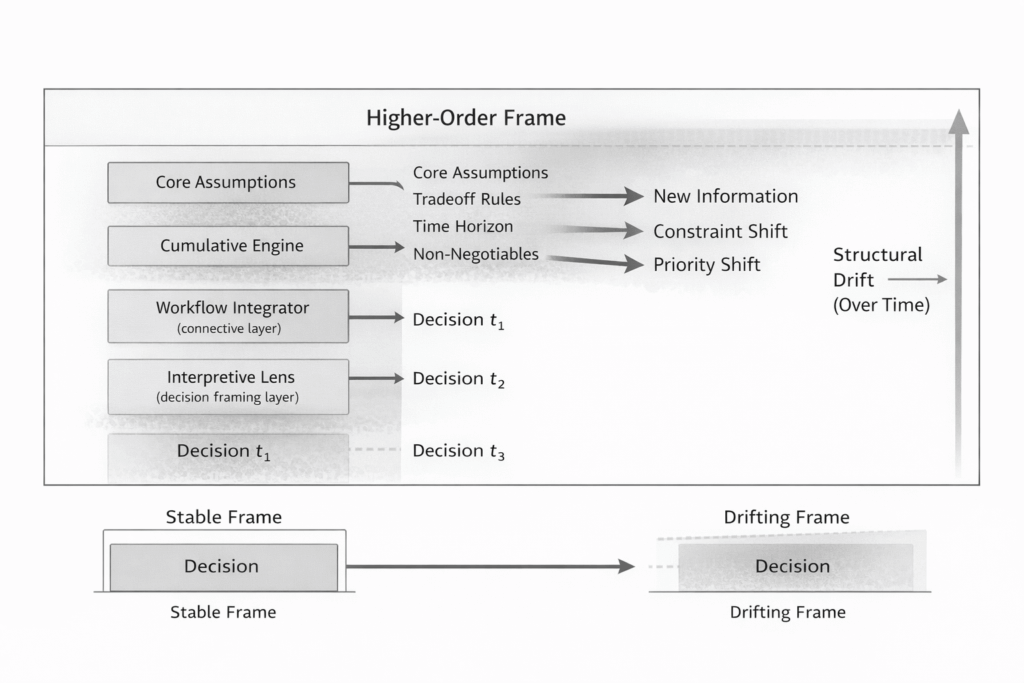
This pattern reflects structural drift: choices are happening faster than the surrounding structure can stabilize. The work continues to reveal new information while the frame those decisions were made within quietly shifts underneath them.
Teams revisit decisions not because they forgot, resisted, or lacked discipline, but because the context that gave the decision meaning changed just enough to loosen its hold.
What looks like backtracking is often real-time recalibration.
Priority Inversion: When the Wrong Things Harden
A second force often compounds this dynamic: priority inversion.
Lower-order decisions—tactical moves, near-term plans, local optimizations—are allowed to harden quickly. Higher-order commitments remain soft:
What must remain true even as conditions change
What tradeoffs are acceptable
What time horizon governs judgment
When those upper constraints aren’t settled, every new signal legitimately reopens what came before. The system isn’t confused. It’s unfinished.
Agreement Without Adhesion
One telltale sign is how little friction accompanies reversal. There’s no drama, no defensiveness, no conflict. Decisions are undone politely and rationally.
That’s because agreement exists, but it doesn’t yet carry authority over future judgment. Decisions function more like weather reports than boundaries: useful, accurate, quickly superseded.
This is why progress can feel real but fragile. Movement happens, but it doesn’t compound.
The Question Isn’t “Are We Missing Something?”
The real question is: what are we expecting decisions to hold right now?
In systems like this, revisiting decisions isn’t a bug. It’s information. It shows you exactly what the system will and won’t allow to settle. Until higher-order conditions stabilize, decisions remain lightweight by necessity.
Nothing is wrong. But nothing is holding yet.
Let the Frame Settle Before Forcing Adhesion
The response isn’t to decide harder or lock things prematurely. It’s to clarify the frame those decisions are meant to live inside:
Which assumptions are stable enough to build on
What must persist even as inputs change
Which decisions are allowed to constrain future choices
Once that frame firms up, decisions stop dissolving—not because people become more disciplined, but because the system finally gives those decisions somewhere solid to land.
What you’re experiencing is normal for work still finding its structural footing. The repetition isn’t a failure of judgment. It’s the system pointing to where stability hasn’t arrived yet—and where it eventually must, if momentum is going to accumulate.