
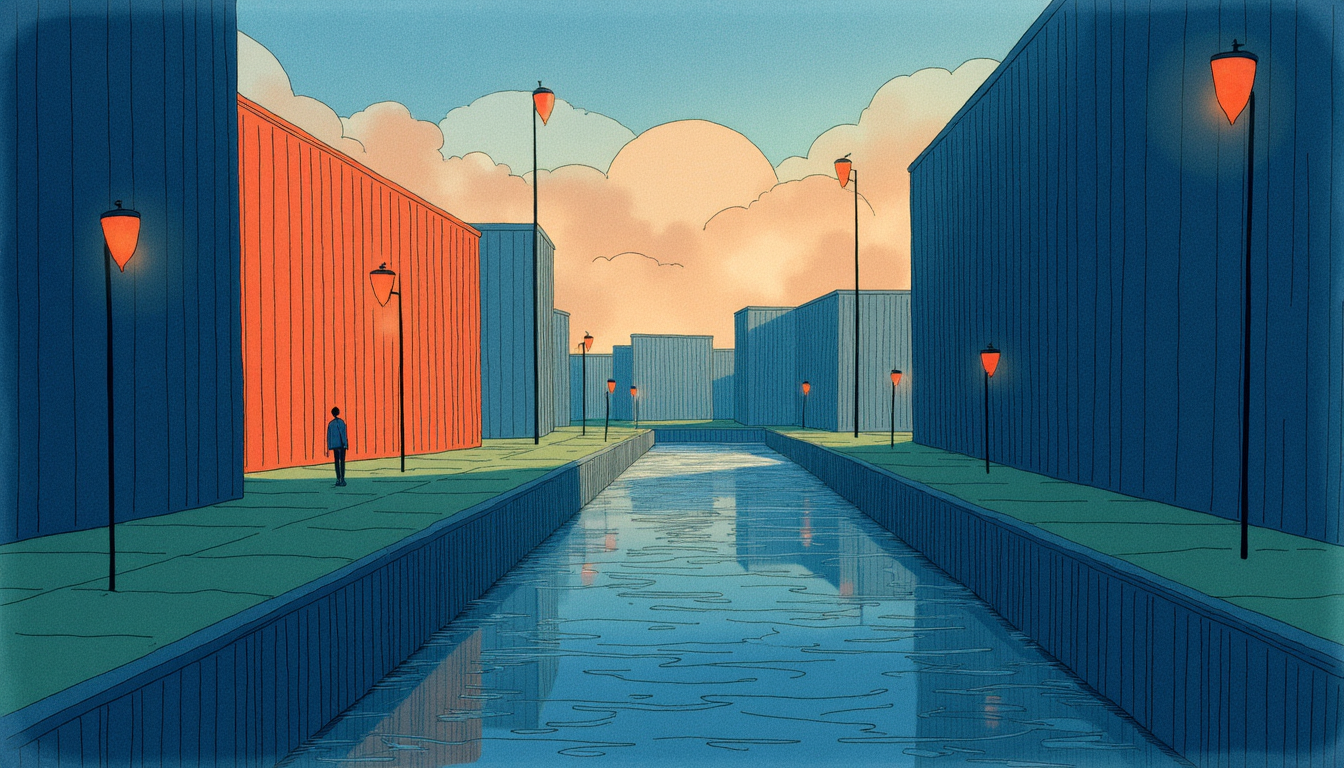
Not all fragmentation is fluid—some of it hardens. A World of Fortresses emerges when nations stop trying to stay connected and start trying to stay protected. Instead of managing interdependence, they retreat into tightly controlled economic and security blocs. The system doesn’t just split—it seals itself.
From Open Networks to Closed Circuits
In highly integrated systems, value flows across borders with minimal friction—goods, capital, information, and security commitments move through shared channels. But when trust erodes and risk perception rises, openness starts to look like exposure.
The response isn’t always to disengage completely—it’s to reconfigure:
- External links are reduced or tightly controlled
- Internal integration within blocs is strengthened
- Boundaries become hardened rather than permeable
What was once a network becomes a set of circuits—connected internally, disconnected externally.
Fortresses as Defensive Architectures
A fortress system is designed not for expansion, but for insulation. Each bloc prioritizes resilience within its own perimeter:
- Economic Containment: Supply chains are localized or restricted to trusted partners
- Security Consolidation: Defense is organized regionally, with limited external reliance
- Information Control: Data and technology ecosystems are bounded and protected
The goal is stability through separation.
Why Systems Turn Inward
Fortress dynamics often emerge from accumulated instability:
- Repeated disruptions make global integration feel unreliable
- Rivalry increases the perceived risk of dependence
- Enforcement asymmetries reduce trust in shared rules
At a certain point, the cost of openness outweighs its benefits—at least in perception. Retrenchment becomes a rational response.
The Trade-Off: Security Over Efficiency
Closed systems gain control but lose optimization:
- Redundancy replaces specialization
- Costs increase as global efficiencies are abandoned
- Innovation may slow without cross-system exchange
But these trade-offs are accepted in exchange for predictability within the bloc. The system prioritizes survivability over performance.
Life at the Boundaries
The most volatile zones in a World of Fortresses aren’t inside the blocs—they’re at the edges:
- Trade friction intensifies at system borders
- Political tension concentrates where blocs intersect
- Smaller actors are pressured to align or risk isolation
Boundaries become both barriers and fault lines.
From Global Order to Parallel Orders
A fortress world doesn’t eliminate order—it multiplies it. Each bloc develops its own rules, standards, and norms. These systems may function effectively internally but struggle to interoperate externally.
The result is coexistence without cohesion.
When Protection Becomes the Organizing Principle
Over time, defensive logic reshapes behavior. Policy decisions prioritize risk reduction over opportunity expansion. Cooperation becomes conditional, limited to trusted circles. Exposure is minimized—even at the cost of potential gains.
In the end, a World of Fortresses isn’t defined by collapse, but by contraction. The global system doesn’t disappear—it withdraws behind walls, reorganizing into self-contained units that trade openness for control, and integration for insulation.

