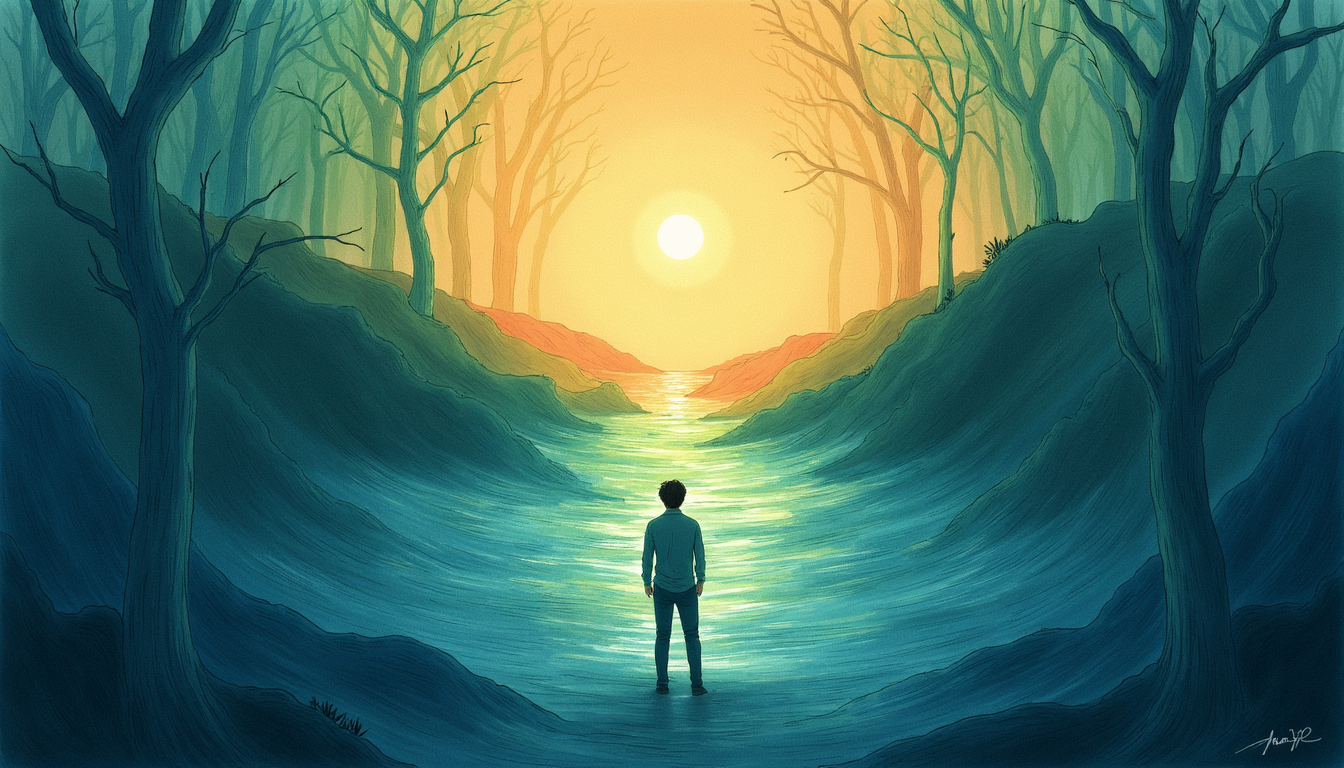
Light is not only something outside a person. It is the condition that allows inner coherence. When someone turns from the light, they are not just stepping out of illumination. They are stepping away from what keeps their inner world aligned.
At first, the movement feels harmless. Protective.
What feels like shelter can quietly become starvation.
Avoidance Feels Like Relief
Exposure is uncomfortable. Truth destabilizes the narratives we use to organize ourselves. Being fully seen threatens the structures that make us feel secure. So turning away often feels strategic. Controlled. Self-preserving.
Darkness reduces friction. It narrows what must be acknowledged. It allows a person to manage what is revealed and what remains hidden.
But relief is not nourishment.
Light does more than expose flaws. It orients. Orientation is the ability to perceive reality accurately enough to move without self-deception or distortion. It tells you where you stand. It clarifies consequences. It aligns perception with what is actually there.
When a person repeatedly avoids that orienting force, they are not just withholding information. They are degrading their own internal map.
Orientation Loss Becomes Identity Drift
The first distortions are relational: selective honesty, managed conversations, curated self-presentation. But the shift does not remain external.
Without steady contact with truth, humility, and relational feedback, the psyche recalibrates. Safety becomes the organizing principle. Reality becomes secondary.
What feels safe replaces what is accurate.
What preserves control replaces what builds character.
What protects ego replaces what strengthens integrity.
Over time, this recalibration becomes identity.
The “light” does not disappear. The capacity to metabolize it weakens. To metabolize truth is to process it without collapsing or deflecting—to let it refine rather than threaten you.
When that capacity erodes, conscience dulls. Connection thins. Self-knowledge fragments. The same reflex that avoids discomfort externally begins to hollow vitality internally.
That is the mechanism: repeated avoidance conditions the self to prefer distortion over clarity.
When Light Begins to Feel Hostile
Avoidance compounds. What once felt clarifying now feels intrusive. What once felt illuminating now feels accusatory. Exposure is interpreted as attack rather than invitation.
This is the tipping point.
Hell, in this sense, is not a punishment imposed at the end of a journey. It is the full maturation of a habit. By the time someone arrives there, light no longer feels life-giving. It feels unbearable.
Not because light changed.
Because they did.
Each turn away edits the self. Tolerance for truth narrows. The aperture of honesty contracts. The nervous system adapts, associating clarity with threat and concealment with relief.
Eventually, darkness feels normal—and clarity feels like harm.
Light Does Not Chase
The metaphor holds because light is not coercive. It does not force compliance. It does not argue its case.
It simply reveals.
The trajectory of a life depends less on whether truth exists and more on whether a person remains willing to face it. Repeatedly. Especially when it destabilizes.
Inner vitality depends on sustained contact with what is real.
The movement away from light is rarely dramatic. It is incremental. Rationalized. Quiet.
And precisely because it is quiet, it reshapes the self so completely.
Not through punishment.
Through slow, self-authored attrition.