
Over the years, I’ve worked with many writers. Most were excellent. A few were challenging. Each taught me something about reliability, communication, and expectations.
Back then, I believed there were six types of writers. Today, there are seven.
The first six are human.
The seventh doesn’t sleep.
As before, names are assigned at random.
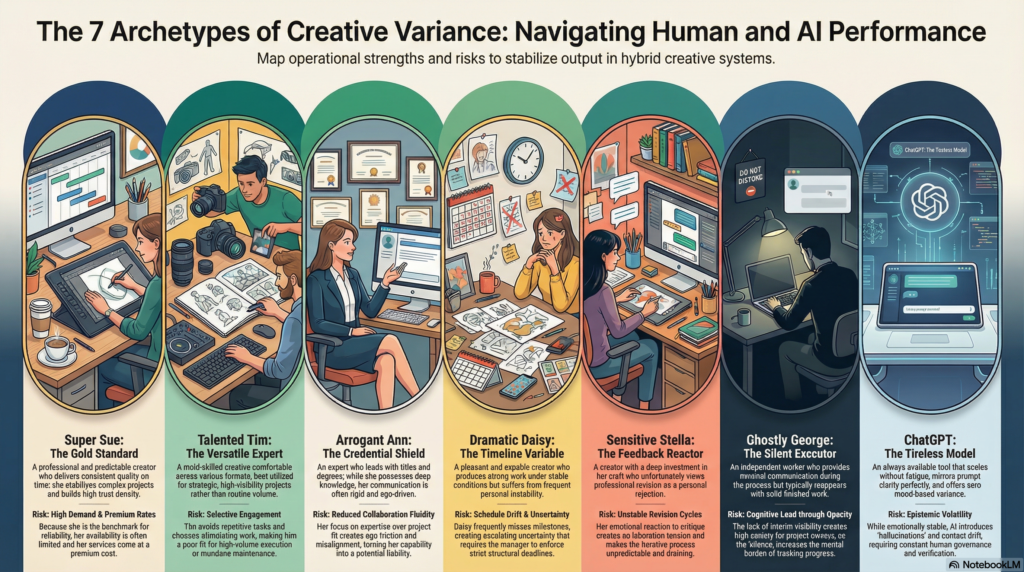
Super Sue
Super Sue is every client’s dream. She has a truthful profile, a solid portfolio, and glowing testimonials. She answers emails promptly, provides updates without being asked, and never misses deadlines. Her work is polished and thoughtful.
If you find a Super Sue, hire her.
The only downside? She’s usually in demand. And she charges accordingly.
What I would do:
Hire Sue for complex or high-stakes projects. Pay her well. Give her time. Protect the relationship.
Talented Tim
Tim can do just about anything—press releases, long-form articles, email campaigns, landing pages, white papers. His portfolio shows range and depth.
The downside? If Tim has real experience, his rates reflect it. He may not be interested in repetitive or mechanical work. He prefers projects that stretch him.
What I would do:
Use Tim for strategic or creative work. Don’t assign him grunt tasks. He’s leverage, not labor.
Arrogant Ann
Ann leads with credentials. Master’s degree. PhD. Published here and there. She may begin her proposal by stating what she doesn’t charge below.
She talks about her achievements—but rarely about your project.
When you ask for a call, she prefers email. When you suggest revisions, she defends her phrasing.
What I would do:
Proceed cautiously—or not at all. Capability without alignment can create friction.
Dramatic Daisy
Daisy is kind and personable. She knows her craft. But life frequently intervenes.
One week it’s a family emergency. Another week it’s a technical failure. Deadlines become fluid.
The work may be good—but the timeline is unpredictable.
What I would do:
Set clear milestones. If early ones are missed, reconsider. Compassion is important—but so is schedule integrity.
Sensitive Stella
Stella takes pride in her work. Deep pride.
The challenge? She struggles with criticism. Even constructive suggestions may feel like rejection. A minor edit can become a major emotional event.
Collaboration becomes delicate.
What I would do:
Offer thoughtful feedback. Explain your reasoning. If she can separate draft from identity, she can be excellent. If not, revision cycles may stall.
Ghostly George
George is fully engaged during recruitment. Prompt replies. Clear interest.
Then—silence.
You don’t hear from him until delivery day. The work is often solid. But during the process, communication is sparse.
Some clients are fine with that. Others find it stressful.
What I would do:
State clearly that you require updates. If communication matters to you, make it part of the agreement.
ChatGPT
ChatGPT is different.
It is always available. It responds instantly. It does not argue. It does not miss deadlines. It does not have bad days.
It can draft blog posts, summarize reports, brainstorm headlines, rewrite awkward paragraphs, and generate ideas at scale.
It never disappears.
But it has its own quirks.
It can sound confident while being slightly wrong.
It can make assumptions that feel logical but are inaccurate.
It mirrors the clarity—or confusion—of your instructions.
If your prompt is vague, its output will be too.
ChatGPT does not have mood swings.
It has interpretation swings.
What I would do:
Use it as a fast collaborator. Give it clear direction. Verify important facts. Refine prompts. Review before publishing.
It won’t take criticism personally. But it won’t fact-check itself either.
What Changed – And What Didn’t
Years ago, hiring writers meant managing personality and reliability. Today, we have a new option—one that removes emotional volatility but introduces interpretive risk.
The interesting thing is this:
Every writer—human or AI—has strengths and limitations.
Super Sue reduces uncertainty.
Talented Tim increases capability.
Arrogant Ann tests alignment.
Dramatic Daisy tests timelines.
Sensitive Stella tests feedback skill.
Ghostly George tests your tolerance for silence.
ChatGPT tests your clarity.
The names may change.
The tools may evolve.
But one thing remains constant:
Good content still requires oversight, structure, and judgment.
The medium shifts.
Responsibility does not.