

Sometimes a team starts with a clear goal.
Everyone understands what success looks like. Decisions feel straightforward. Work moves in a consistent direction.
But over time something subtle begins to change. New priorities appear. Different stakeholders push for different outcomes. Meetings begin to revolve around resolving competing interpretations of what matters most.
No one officially changed the goal – yet the system no longer moves in a single direction.
This is how drift begins.
Systems Layer
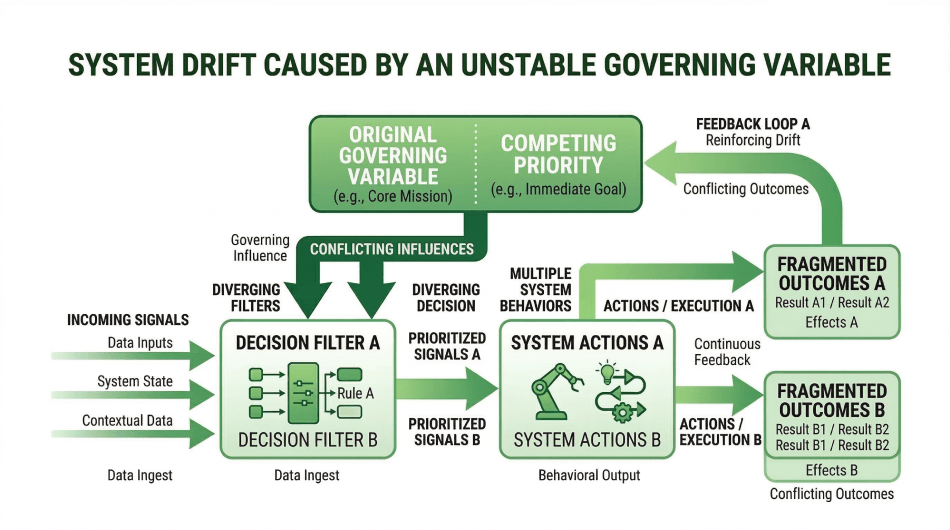
In Systems Language, drift occurs when the governing variable of a system becomes unstable, ambiguous, or contested.
A system maintains alignment when its governing variable provides a stable reference condition for decisions. This reference condition allows signals to be ranked, filtered, and acted upon consistently.
When the governing variable becomes unclear, the system loses its central reference.
Without a stable governing variable:
- signals compete without a clear priority structure
- decision filters interpret situations inconsistently
- behavioral responses diverge across different parts of the system
The system does not stop functioning. Instead, it begins to fragment into multiple local interpretations of priority.
Each part of the system continues operating, but it is now stabilizing around slightly different governing variables.
This creates structural drift.
Over time, feedback loops reinforce these local interpretations. The longer the drift continues, the more difficult realignment becomes.
Structural Translation
In simple terms, drift happens when people stop agreeing on what matters most.
At first, the differences are small.
One group prioritizes efficiency. Another prioritizes thoroughness. Another prioritizes customer experience. None of these priorities are wrong, but they are not the same.
Without a clear governing variable to resolve those differences, decisions start to vary depending on who is involved.
Work still gets done. Effort remains high.
But the system slowly moves in multiple directions at once.
Structural Implication
In organizations and teams, drift rarely appears as a dramatic failure.
Instead, it shows up as subtle friction:
- projects that feel harder to coordinate
- increasing debate over priorities
- inconsistent decisions across teams
- strategies that change depending on context
Leaders often respond by introducing more rules, oversight, or process.
But these solutions operate downstream of the real problem.
The structural issue is not lack of effort or control.
It is the absence of a stable governing variable.
Without that anchor, the system naturally spreads into competing interpretations of direction.
Leverage Insight
Systems rarely collapse suddenly.
More often, they drift slowly after losing a clear governing variable.
The most effective intervention is not increased activity or tighter control. It is restoring a clear orientation that stabilizes decision priorities across the system.
Within the five-pillar framework, Orientation functions as the stabilizing reference that prevents structural drift.
