
Improving efficiency feels productive.
Teams streamline workflows, remove bottlenecks, automate tasks, and reduce wasted time. The system starts moving faster and with less friction.
But sometimes, after all the improvements, something unexpected happens.
The system becomes very good at producing results that nobody actually wanted.
The issue isn’t the quality of the improvements. The issue is that the system was optimized before its direction was fully clarified.
Systems Layer
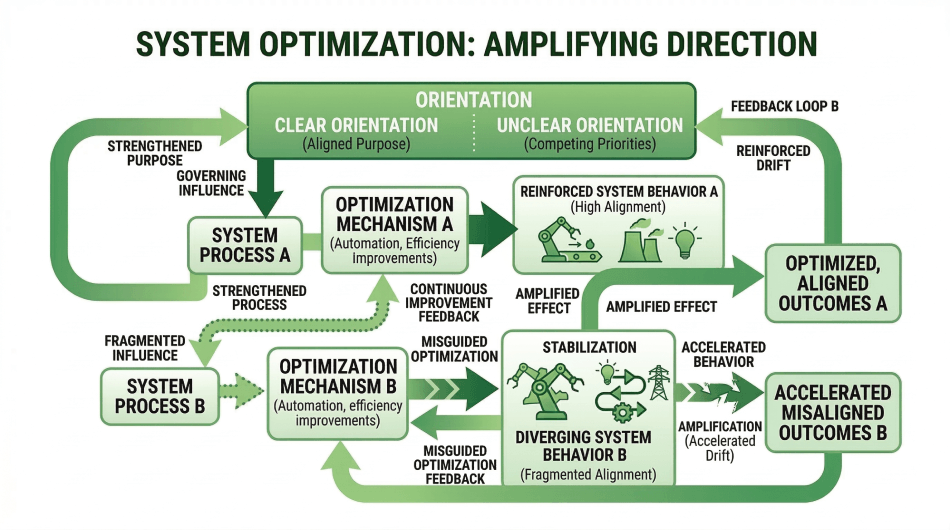
In Systems Language, optimization amplifies the behavior already stabilized by the system’s governing variables.
Optimization mechanisms – such as automation, efficiency improvements, or process acceleration – increase the system’s capacity to produce outcomes along its current trajectory.
However, these mechanisms do not determine direction.
Direction is defined by orientation, which establishes the governing variable that determines which signals the system prioritizes and which outcomes it attempts to stabilize.
When orientation is unclear or unstable, the system may already be drifting toward unintended priorities.
If optimization occurs under these conditions, the system simply becomes more efficient at executing the wrong trajectory.
Optimization strengthens the existing feedback loops within the system. If those loops are aligned with the intended orientation, performance improves.
If they are misaligned, optimization accelerates misalignment.
Structural Translation
In simple terms, optimization makes a system faster at doing whatever it is already doing.
If the system is moving in the right direction, efficiency improvements help it get there faster.
But if the system is heading slightly off course, improving efficiency doesn’t correct the direction – it just increases the speed of the mistake.
This is why some organizations become extremely efficient while still struggling to achieve the outcomes they want.
They optimized the system before confirming that it was pointed in the right direction.
Structural Implication
In organizations and operational systems, the pressure to improve efficiency often appears before the system’s orientation is fully clarified.
Leaders introduce automation, new tools, streamlined processes, and performance metrics designed to increase output.
But if teams are already interpreting priorities differently, these improvements can amplify divergence rather than resolve it.
Instead of correcting misalignment, the system becomes faster, more complex, and harder to redirect.
Correcting direction after optimization often requires reversing or redesigning the improvements that were just implemented.
This makes early orientation clarity structurally valuable.
Leverage Insight
Efficiency multiplies direction.
If orientation is clear, optimization compounds progress.
If orientation is unclear, optimization compounds drift.
Within the five-pillar framework, Orientation must stabilize the system before optimization mechanisms are introduced.
Direction first. Acceleration second.