
Some systems remain steady even under pressure.
When conditions become uncertain – deadlines tighten, resources shrink, or unexpected problems appear – these systems continue making consistent decisions. People inside them may feel the pressure, but the direction of the system does not suddenly change.
Other systems behave very differently.
When pressure increases, priorities shift quickly. Decisions become reactive. Teams begin interpreting goals differently, and coordination becomes harder just when clarity is needed most.
The difference often lies in whether the system has a stable center.
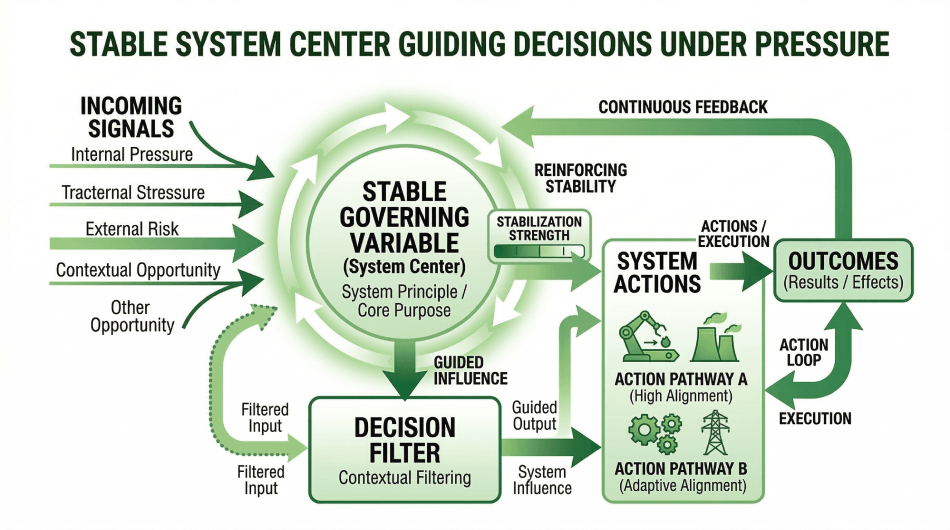
Systems Layer
In Systems Language, a stable center is the governing variable that consistently anchors decision-making across the system.
It functions as a structural reference condition that remains stable even when environmental signals fluctuate.
All systems must process incoming signals such as uncertainty, opportunity, risk, and time pressure. When these signals intensify, they compete more aggressively for attention within the system.
If the governing variable is unstable, the system begins responding to whichever signal appears most urgent. Decision priorities shift rapidly as new pressures emerge.
However, when a system maintains a stable center, incoming signals are interpreted relative to the governing variable rather than reacting directly to external pressure.
The governing variable acts as a stabilizing constraint that keeps the system aligned even when environmental signals become noisy or conflicting.
Over time, feedback loops reinforce this stability. Decisions consistently reference the same governing variable, strengthening the system’s internal coherence.
Structural Translation
In simple terms, a stable center is the principle that the system refuses to abandon when things become difficult.
When pressure rises, people naturally feel the need to react quickly. Without a clear center, each person or team may respond to different pressures in different ways.
But when the system’s center is well understood, decisions remain consistent. People know which priorities must be protected even when conditions change.
The system may adapt its actions, but it does not lose its direction.
Structural Implication
In organizations, unstable systems often reveal themselves during moments of stress.
When pressure increases, leaders introduce new priorities, teams reinterpret goals, and the system begins chasing short-term signals rather than maintaining long-term direction.
This produces reactive behavior: frequent strategy shifts, inconsistent decisions, and rising coordination costs.
Strong systems behave differently.
Because their governing variable is stable, pressure does not change the system’s direction. Instead, pressure simply tests whether the system continues to operate according to its center.
The result is structural resilience rather than reactive instability.
Leverage Insight
A system does not become stable by reducing pressure.
It becomes stable by anchoring decisions to a governing variable that remains consistent under pressure.
Within the five-pillar framework, Orientation establishes the stable center that allows the system to maintain direction despite changing conditions.