
Most teams are familiar with goals.
Quarterly targets, project milestones, revenue objectives, product launches – organizations use goals to focus effort and measure progress. They provide something specific to work toward.
But problems often appear when systems confuse goals with direction.
A team might achieve its goal and still feel uncertain about what comes next. Another team may chase multiple goals that seem to conflict with each other.
When this happens, the issue is not the goals themselves.
The issue is that the system lacks a stable orientation beneath those goals.
Systems Layer
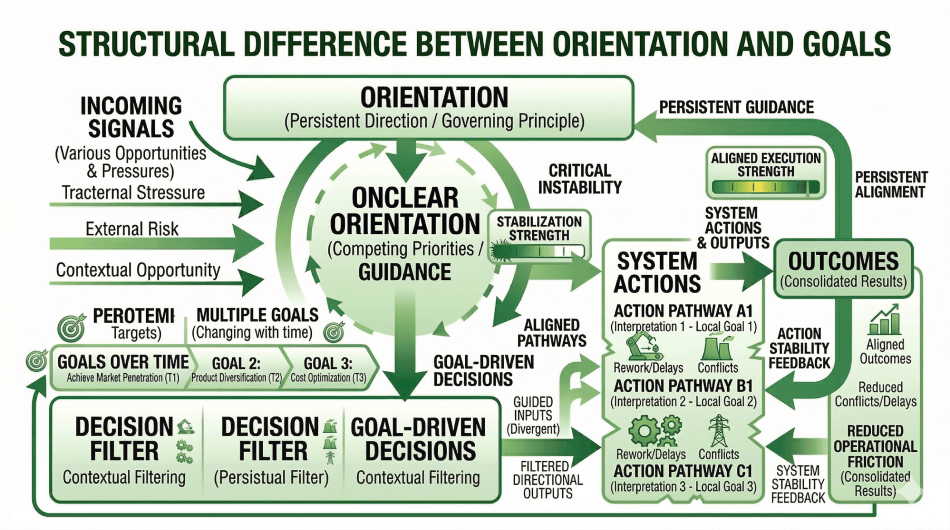
In Systems Language, goals and orientation operate at different structural levels within a system.
A goal is a temporary target condition the system attempts to reach. It represents a specific state or outcome that can be achieved, measured, and completed.
Orientation, by contrast, is the governing direction that persists across decisions over time.
Orientation establishes the system’s governing variable – the priority condition that determines how signals are interpreted, trade-offs are resolved, and decisions are filtered.
Because goals are temporary, they change as the system progresses or as conditions evolve.
Orientation remains stable across these changes.
In well-structured systems, goals operate within the constraints established by orientation. They act as intermediate checkpoints along a consistent directional path.
Without orientation, goals may pull the system in different directions, creating fragmentation in behavior and decision making.
Structural Translation
In simple terms, goals tell the system where to go next, while orientation determines which direction the system is always facing.
A goal might be:
- Launch a product
- Reduce operational cost
- Increase customer adoption
These are destinations that can eventually be reached.
Orientation, however, answers a deeper question:
What principle or priority should guide decisions even after this goal is completed?
If orientation is clear, goals naturally align with each other because they are all moving in the same underlying direction.
If orientation is unclear, goals can compete with each other, creating confusion inside the system.
Structural Implication
Many organizations unintentionally treat goals as if they provide direction.
This creates instability.
When one goal is completed, the system must search for the next one. Each new target can shift priorities, producing cycles of constant reorientation.
Teams may feel as though the system is repeatedly changing direction even though leadership believes it is simply setting new objectives.
Strong systems avoid this problem by anchoring goals to a stable orientation.
The direction remains consistent, while goals serve as temporary markers along that path.
Leverage Insight
Goals create focus.
Orientation creates direction.
Within the five-pillar framework, Orientation provides the persistent directional constraint that allows changing goals to remain aligned across time.