
Most systems appear stable when conditions are calm.
Plans are followed. Processes run smoothly. Teams coordinate without much difficulty. The organization seems aligned around shared priorities.
But the real test of a system rarely happens during calm periods.
It happens when pressure increases – deadlines tighten, risks emerge, resources shrink, or unexpected events disrupt normal operations.
In those moments, something important becomes visible.
The system reveals what it actually prioritizes.
Systems Layer
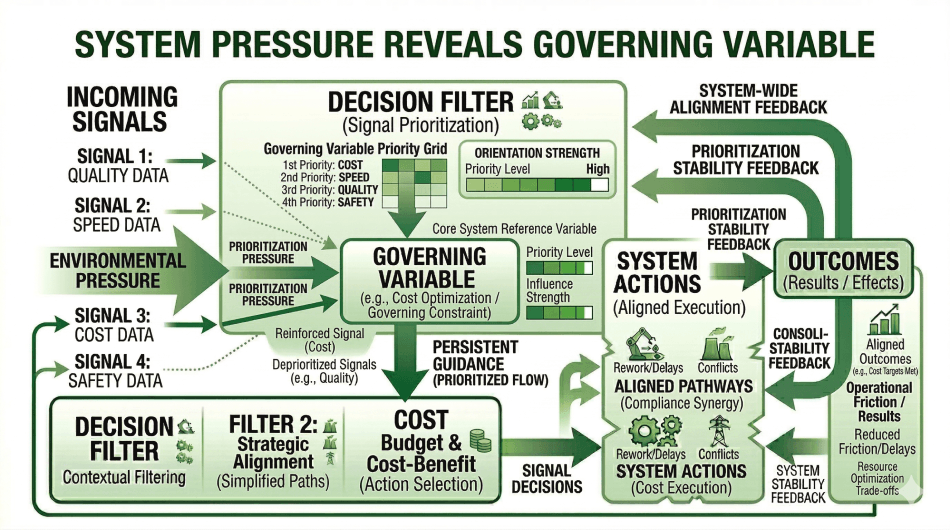
In Systems Language, pressure functions as a signal amplifier that exposes a system’s true governing variable.
When environmental conditions are stable, systems can maintain multiple priorities simultaneously. Trade-offs are manageable, and decision conflicts can often be avoided or postponed.
Under pressure, however, trade-offs become unavoidable.
Time constraints, risk exposure, and resource limitations force the system to resolve competing signals quickly. Decision filters must determine which outcomes the system will protect and which it is willing to sacrifice.
At this point, the governing variable becomes visible.
The system begins consistently favoring certain signals over others. Some priorities are protected even when they create difficulty elsewhere. Other priorities are quietly abandoned.
These decision patterns reveal the actual orientation of the system, regardless of its stated intentions.
Pressure does not create the orientation.
It simply removes the system’s ability to hide it.
Structural Translation
In simple terms, stress shows what the system truly values.
When things are easy, organizations can claim many priorities at once: quality, speed, innovation, safety, cost efficiency.
But when pressure forces a choice, the system must decide which of those priorities matters most.
If deadlines tighten, does the system sacrifice quality or delay delivery?
If costs rise, does it reduce investment or protect capability?
If risk increases, does it slow down or continue forward?
The answers to those decisions reveal the system’s real orientation.
Not the one written in strategy documents – the one embedded in how decisions are actually made.
Structural Implication
Organizations often misunderstand the role of pressure.
When systems behave differently during stressful periods, leaders may assume the problem is emotional reaction, poor judgment, or lack of discipline.
But from a systems perspective, these moments often reveal something structural.
If the system repeatedly sacrifices certain priorities under pressure, those priorities were never the governing variable to begin with.
They were secondary signals tolerated only when conditions allowed.
Understanding this dynamic is valuable because it helps organizations identify the true orientation already guiding their system.
Leverage Insight
Pressure does not redefine a system.
It reveals which governing variable the system stabilizes around when trade-offs become unavoidable.
Within the five-pillar framework, Orientation becomes most visible under pressure, because urgency forces the system to act according to its deepest structural priority.