

Most systems claim to value many things.
An organization may say it values innovation, quality, customer satisfaction, efficiency, safety, and growth – all at the same time. On paper, these priorities appear equally important.
But real decisions rarely allow everything to be protected simultaneously.
When trade-offs appear – when time is limited, risks increase, or resources are constrained – the system must choose which priorities to protect and which to compromise.
These moments reveal something deeper than strategy.
They reveal the system’s value hierarchy.
Systems Layer
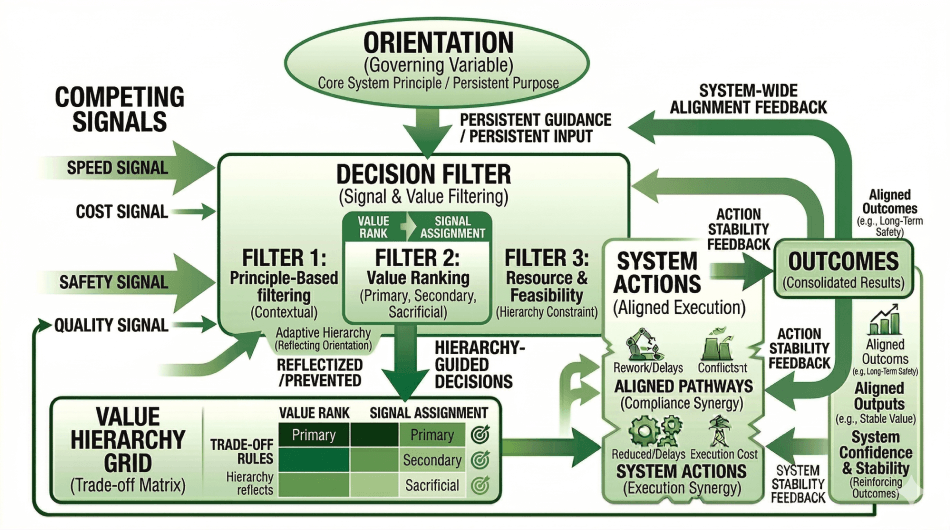
In Systems Language, orientation establishes the value hierarchy that determines how a system resolves trade-offs.
A value hierarchy is the ordered structure that ranks which signals, outcomes, and priorities the system will protect first when constraints require a decision.
Orientation defines the governing variable at the top of this hierarchy.
When competing signals appear – such as speed versus safety, innovation versus reliability, or cost versus quality – the governing variable determines which signal receives priority.
The hierarchy emerges structurally through repeated decision patterns.
Over time, the system stabilizes around consistent trade-offs. Certain values are repeatedly protected while others are occasionally sacrificed.
This produces a predictable hierarchy:
- Primary values – protected even under pressure
- Secondary values – supported when conditions allow
- Sacrificial values – compromised when trade-offs become necessary
Orientation determines which values occupy each level.
Structural Translation
In simple terms, a system’s orientation determines what it protects first when it cannot protect everything.
Most organizations believe they value many things equally. But real decisions reveal that some priorities matter more than others.
For example:
- A system oriented toward speed may sacrifice thoroughness when deadlines tighten.
- A system oriented toward safety may sacrifice efficiency to reduce risk.
- A system oriented toward cost control may sacrifice flexibility or innovation.
These decisions are not random.
They follow the value hierarchy established by the system’s orientation.
Structural Implication
Organizations sometimes struggle because their stated values do not match their structural value hierarchy.
Leaders may communicate that quality is the top priority, while operational incentives reward speed. Teams may believe innovation is valued, while decision processes consistently prioritize risk reduction.
When these mismatches occur, confusion emerges.
People attempt to follow stated values, but the system’s decisions reinforce a different hierarchy.
The result is tension between what the system says it values and what it consistently protects.
Clarity improves when the organization identifies the orientation that actually governs trade-offs and aligns its messaging and structure accordingly.
Leverage Insight
Values only become operational when the system must choose between them.
The priority that survives the trade-off reveals the system’s true orientation.
Within the five-pillar framework, Orientation determines the value hierarchy that guides which outcomes the system protects and which it is willing to sacrifice.
