
Some organizations appear unusually consistent.
Decisions made by different teams tend to point in the same direction. New employees quickly learn “how things are done.” Even when leadership changes or processes evolve, the system’s behavior remains surprisingly stable.
What is interesting is that this consistency often exists without a clearly written rule explaining it.
People inside the system may struggle to articulate the principle guiding their decisions. Yet they instinctively know when something feels “off direction.”
This is often the result of an invisible center.
Systems Layer
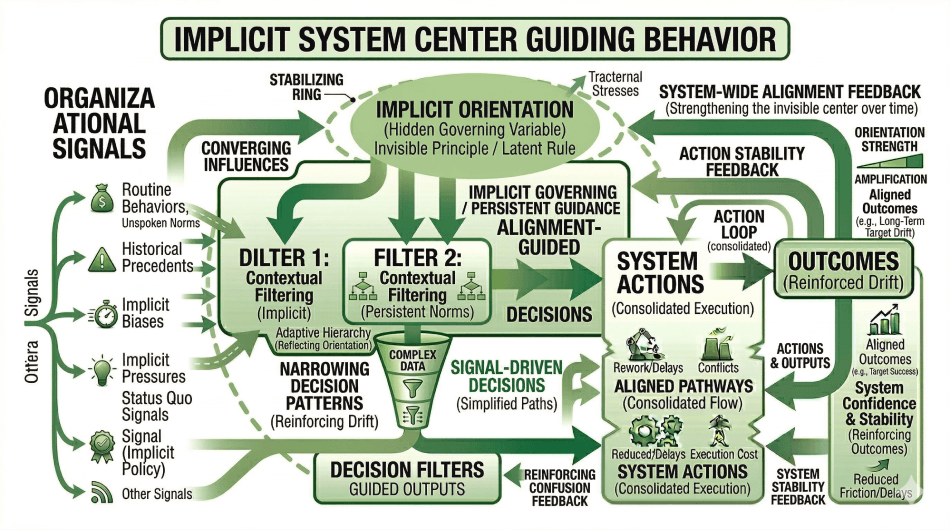
In Systems Language, strong systems often stabilize around an implicit governing variable that functions as the system’s center of orientation.
This governing variable may not be formally documented or explicitly communicated. Instead, it emerges through repeated interactions between decision filters, incentives, leadership signals, and feedback loops.
Over time, these repeated patterns establish a stable reference condition.
Once this reference condition exists, system participants begin internalizing it. Decision-making becomes guided by a shared understanding of which signals the system prioritizes and which trade-offs are acceptable.
This implicit center functions structurally the same way as an explicit orientation:
- it filters incoming signals
- it resolves trade-offs
- it stabilizes decision patterns
- it reinforces consistent system behavior
The difference is that the orientation operates through embedded practice rather than formal definition.
Structural Translation
In simple terms, people in the system learn the direction by observing how decisions are actually made.
They notice patterns.
They see which priorities leadership protects. They observe which outcomes receive recognition or criticism. They learn what kinds of decisions succeed and which ones fail.
Over time, these patterns create an unwritten rule about what the system truly values.
Even if nobody formally states the system’s orientation, people begin acting according to it.
The system develops a shared sense of direction that lives inside behavior rather than inside documents.
Structural Implication
Implicit centers can make systems surprisingly resilient.
Because the orientation is embedded in everyday behavior, it continues guiding decisions even when leadership changes or formal processes are updated.
However, implicit orientation also carries risk.
If the system’s center is never articulated, different parts of the organization may interpret it differently over time. New employees may struggle to understand the underlying priorities. Leaders may unintentionally shift the system’s direction without recognizing it.
Making the center visible does not necessarily change the system’s orientation – but it helps ensure that the direction remains stable as the system grows.
Leverage Insight
Strong systems often behave consistently because they have an invisible center guiding decisions.
Within the five-pillar framework, Orientation becomes most powerful when it is not only stated but embedded deeply enough in system behavior that it continues guiding decisions even when no one explicitly references it.