

Growth is usually treated as a sign that a system is working.
Customers increase, teams expand, new products are introduced, and operations become more sophisticated. From the outside, expansion looks like success.
But inside the system, growth often introduces a quieter problem.
As complexity increases, decisions become harder to coordinate. Different teams interpret priorities differently. New initiatives appear that do not clearly connect to the system’s original purpose.
The system continues growing – but its direction becomes less clear.
This is one way growth can break orientation.
Systems Layer
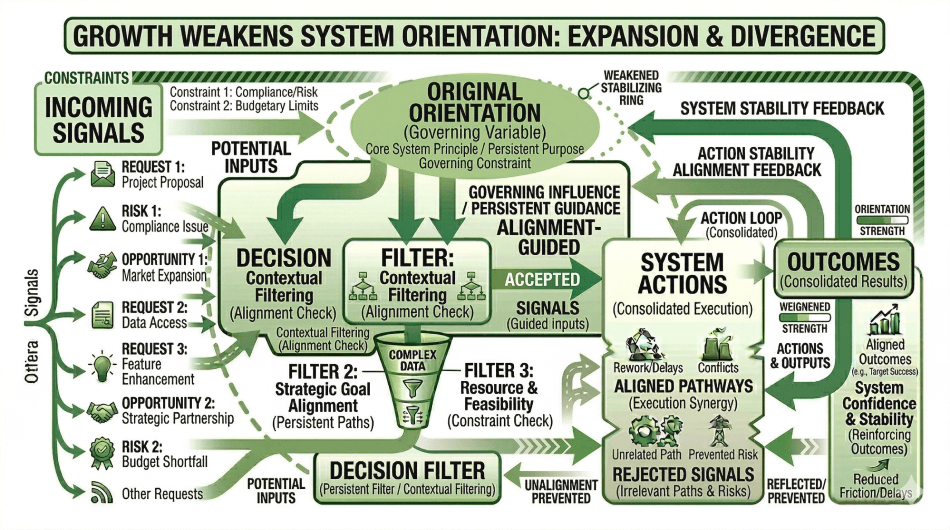
In Systems Language, expanding systems experience structural complexity growth, which increases the number of signals, decision points, and interacting subsystems within the environment.
When a system is small, orientation naturally stabilizes behavior because the number of interactions is limited. Decision pathways are short, and participants share a common understanding of priorities.
As the system expands, three structural pressures emerge:
- Signal Amplification
More customers, markets, products, and stakeholders introduce additional signals competing for attention. - Subsystem Formation
New departments, roles, and processes form semi-independent subsystems that begin stabilizing around local priorities. - Decision Distance
The distance between orientation and operational decisions increases, making it harder for the governing variable to influence everyday choices.
If orientation is not actively reinforced, these pressures weaken its influence across the system.
The result is not immediate failure.
Instead, the system gradually transitions from a single shared orientation to multiple local orientations.
Structural Translation
In simple terms, growth makes it easier for parts of the system to start moving in different directions.
When the organization was small, everyone understood what mattered most. Decisions naturally aligned because the system’s direction was close to the people making those decisions.
But as the organization expands, new teams join, new opportunities appear, and more decisions are made further away from the original center.
Without reinforcement, people begin optimizing for local goals rather than system direction.
The system keeps expanding, but alignment becomes harder to maintain.
Structural Implication
Many organizations assume that alignment problems during growth are caused by communication breakdowns.
As a result, they introduce more coordination mechanisms: additional meetings, reporting layers, and complex processes.
While these tools help manage complexity, they do not solve the underlying issue if orientation itself has weakened.
Without a strong governing direction, each subsystem stabilizes around its own priorities.
The organization grows larger but becomes structurally fragmented.
Sustainable growth requires not only expanding the system’s capacity but preserving the strength of its orientation as complexity increases.
Leverage Insight
Growth increases complexity.
Complexity increases the distance between decisions and direction.
Within the five-pillar framework, Orientation must be continuously reinforced as systems expand, or growth will gradually replace shared direction with competing local priorities.
