
Some systems remain steady even when their environment changes.
Markets shift. Technologies evolve. New competitors appear. Internal structures grow more complex. Yet despite these changes, certain organizations continue operating with surprising consistency.
Their decisions still follow the same logic. Their behavior still reflects the same priorities. Even when strategies adapt, the system’s overall direction feels stable.
Other systems respond very differently.
Every new pressure triggers a shift in priorities. Strategies change frequently. Teams become uncertain about what matters most.
The difference often lies in whether the system protects its central variable.
Systems Layer
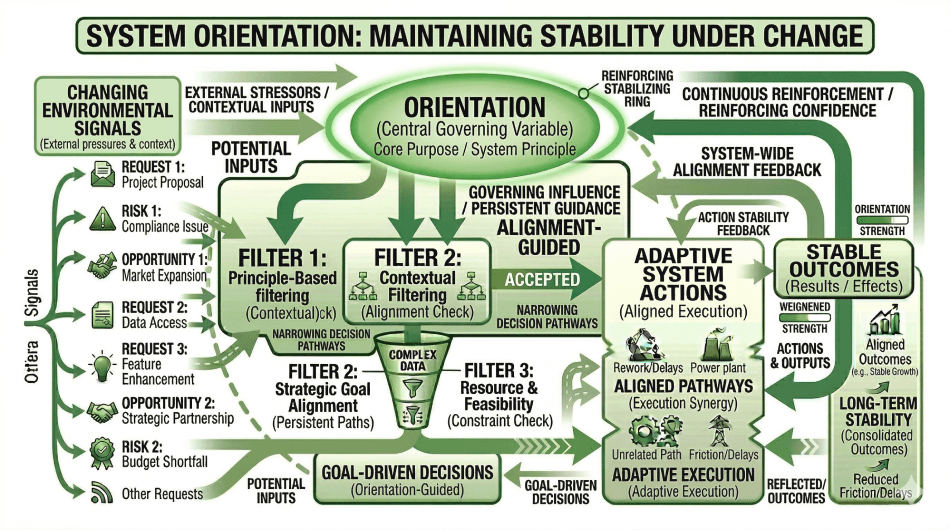
In Systems Language, stability emerges when a system protects its governing variable while allowing surrounding structures to adapt.
Orientation defines the governing variable – the priority condition the system attempts to maintain when processing signals and resolving trade-offs.
When environmental signals change, the system must adapt in order to continue functioning. Processes may evolve, structures may shift, and strategies may adjust.
However, if these adaptations occur while the governing variable remains stable, the system retains its orientation.
The governing variable acts as the stabilizing reference point that organizes change.
Instead of reacting to each signal independently, the system evaluates change relative to its orientation. Adaptations that reinforce the governing variable are accepted. Changes that threaten it are resisted.
This produces a system that can change its methods while preserving its direction.
Structural Translation
In simple terms, stable systems change how they operate without changing what they protect.
The environment may require new tools, new strategies, or new ways of working.
But the underlying priority – the principle the system refuses to compromise – remains constant.
For example:
- A system oriented around customer trust may adapt its products, technologies, and processes while continuing to protect transparency and reliability.
- A system oriented around safety may introduce new technologies while refusing shortcuts that increase risk.
- A system oriented around long-term value may reject short-term opportunities that undermine sustainability.
Because the system protects its core priority, change does not destabilize it.
Structural Implication
Organizations sometimes mistake stability for resistance to change.
In reality, strong systems are often highly adaptive.
What distinguishes them is that they separate method from orientation.
Processes, tools, and strategies can evolve as needed. But the governing variable guiding decisions remains protected.
When orientation weakens, however, change becomes destabilizing.
Each new pressure can redefine the system’s priorities. Teams become uncertain about which trade-offs are acceptable, and decisions begin shifting unpredictably.
Without a stable center, adaptation turns into directional instability.
Leverage Insight
Stability does not come from preventing change.
It comes from protecting the governing variable that organizes change.
Within the five-pillar framework, Orientation functions as the stabilizing center that allows systems to adapt their structure and behavior without losing their direction.