
Sometimes a system slowly loses its direction.
At first the change is subtle. Teams interpret priorities differently. Projects expand beyond their original purpose. Decisions begin to feel inconsistent across departments.
Over time the symptoms become more visible. Strategy debates increase. Coordination requires more effort. People spend more time negotiating priorities than executing work.
At that point, leaders often try to fix the problem through restructuring, new processes, or stronger oversight.
But when alignment has been lost, the real challenge is usually simpler.
The system needs to recover its direction.
Systems Layer
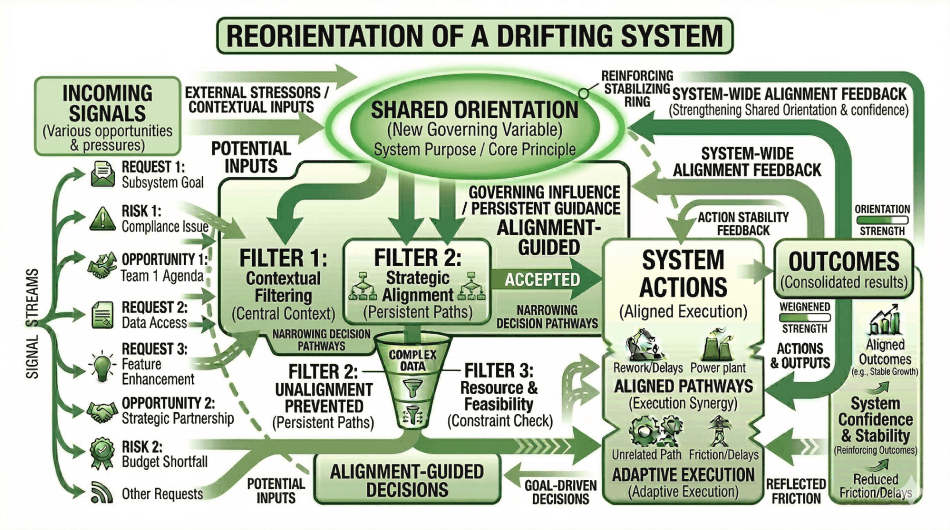
In Systems Language, reorienting a drifting system involves restoring a stable governing variable that can again function as the system’s primary reference condition.
Drift occurs when the original orientation weakens and multiple subsystems stabilize around local governing variables. Decision filters across the system begin prioritizing different signals.
Reorientation requires reversing this fragmentation.
Structurally, this involves three sequential adjustments:
- Surface the Existing Governing Variables
Leaders must identify which priorities are currently stabilizing different parts of the system. These may include speed, cost control, risk reduction, growth, or operational efficiency.
Understanding these variables reveals why decisions across the system are diverging.
- Define the Intended Orientation
The system must establish a single governing variable that will resolve trade-offs across subsystems. This orientation becomes the reference condition that decisions should align with.
- Reconnect the Decision Spine
Orientation must then be structurally embedded into the system’s decision filters, incentives, and feedback loops. Without this connection, orientation remains symbolic rather than operational.
Through these adjustments, the system gradually shifts from multiple competing orientations back to a shared center.
Structural Translation
In simple terms, reorienting a system means helping everyone return to the same answer to a basic question:
What matters most when we have to make a difficult decision?
When that answer becomes unclear, different teams create their own interpretations. Each group begins protecting different priorities, and the organization starts pulling in multiple directions.
Reorientation happens when leaders clarify the system’s core priority and ensure that decisions throughout the organization consistently reflect it.
Once that shared direction becomes visible again, coordination improves naturally.
Structural Implication
Many organizations attempt to restore alignment by introducing new processes or structural changes.
While these interventions can improve coordination, they rarely resolve drift if the governing variable remains unclear.
Without a shared orientation, new structures simply organize existing misalignment.
Effective reorientation occurs when leadership focuses first on re-establishing the system’s central variable, and only then adjusts processes, incentives, and structures to support it.
When the system’s center becomes clear again, teams regain a stable reference point for decisions.
Alignment begins to rebuild across the organization.
Leverage Insight
Systems drift when their governing variable weakens.
They realign when a clear center is restored and embedded into decision-making.
Within the five-pillar framework, Orientation provides the structural anchor that allows leaders to re-stabilize systems that have gradually lost their direction.