

Many people feel busy but not necessarily directed.
Tasks accumulate throughout the day – emails, meetings, requests, ideas, opportunities. Each item may seem important in isolation, yet by the end of the week it can be difficult to explain what progress was actually made.
The problem is often framed as a productivity issue. People look for better tools, improved time management techniques, or more efficient workflows.
But the deeper issue may not be efficiency.
It may be that the personal system lacks a clear orientation.
Systems Layer
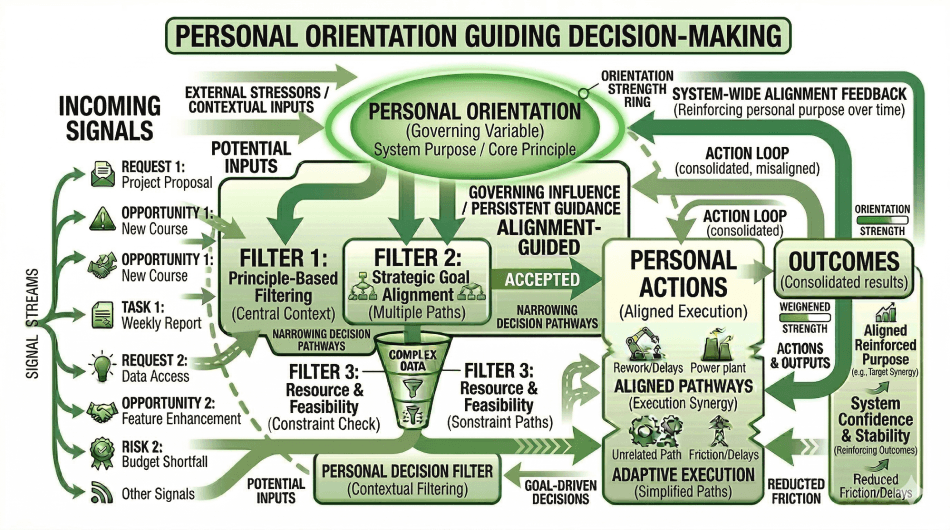
In Systems Language, individuals operate as decision systems that continuously process signals from their environment.
These signals include responsibilities, opportunities, obligations, requests from others, and internal motivations. Each signal competes for attention and action.
Without a governing variable, the personal system must evaluate every signal independently. This increases cognitive load and leads to reactive behavior, where decisions are driven by urgency, visibility, or external pressure.
When a personal orientation exists, however, it functions as a governing variable for individual decision filters.
The orientation determines which signals deserve attention and which signals can be ignored. It stabilizes trade-offs between competing priorities such as speed versus depth, exploration versus focus, or short-term tasks versus long-term development.
Over time, the system begins filtering decisions through this orientation, producing more consistent behavior and reducing decision friction.
Structural Translation
In simple terms, personal orientation answers the question:
What principle guides my decisions when everything feels important?
Without that answer, daily choices become reactive. Tasks are completed based on urgency, external pressure, or habit rather than direction.
With a clear orientation, however, many decisions become easier.
For example, someone whose orientation prioritizes long-term capability building may decline opportunities that offer short-term gains but little learning. Someone oriented toward creating leverage may focus on systems and tools rather than repeating manual effort.
The orientation does not eliminate work. It simply helps determine which work deserves attention.
Structural Implication
Many productivity systems focus on managing tasks rather than clarifying direction.
Lists become longer. Scheduling becomes more complex. Tools multiply.
But if the personal system lacks orientation, improved task management simply makes it easier to execute work that may not contribute to meaningful outcomes.
When orientation becomes clear, task selection improves. Individuals spend less time evaluating every request and more time focusing on work that reinforces their governing direction.
The system becomes not only more productive, but more coherent.
Leverage Insight
Personal productivity improves when decisions are guided by a governing variable rather than by urgency.
Within the five-pillar framework, Orientation provides the directional anchor that allows individuals to filter signals, reduce cognitive load, and concentrate effort on actions that reinforce their intended direction.
