

When a structure is strong, everything attached to it behaves predictably.
A building holds its shape because its internal frame distributes forces in a stable way. Even when wind pushes against the outside, the structure remains coherent because its internal supports keep everything aligned.
Systems behave in a similar way.
When direction is clear, teams, processes, and decisions reinforce each other. Work flows smoothly because each part of the system moves within the same structural logic.
But when that internal structure weakens, the system begins to feel unstable. Coordination becomes harder. Decisions feel inconsistent. Effort increases, yet alignment decreases.
Often the missing element is the system’s structural core.
Systems Layer
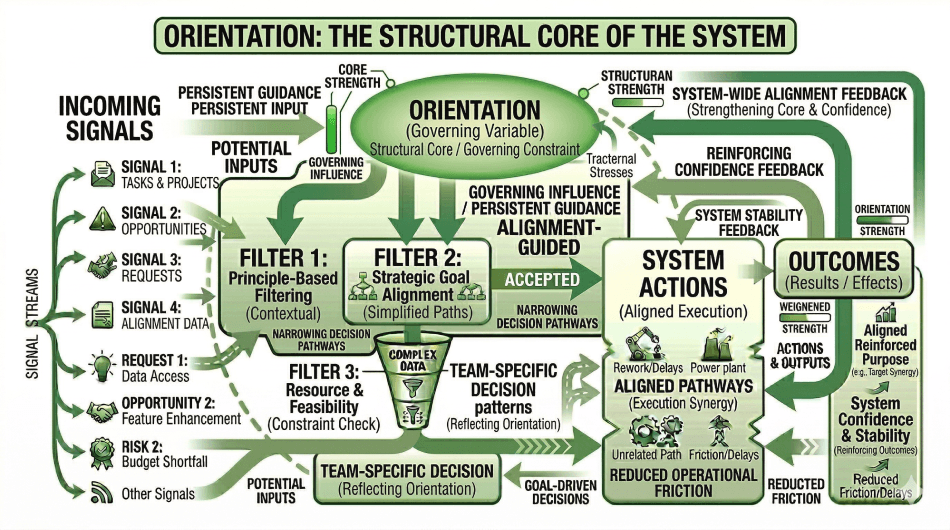
In Systems Language, orientation functions as the structural integrity of a system.
Orientation establishes the governing variable that organizes how the system interprets signals, resolves trade-offs, and produces decisions. This governing variable acts as a central structural constraint around which other components operate.
Just as a structural frame holds physical components together, orientation holds behavioral components together.
Teams, processes, tools, and decision mechanisms attach to the system through this governing variable. Their actions may vary in form, but they remain coherent because they reference the same directional center.
When orientation is stable:
- decision filters operate consistently
- subsystems reinforce the same priority structure
- feedback loops strengthen alignment
The system behaves as an integrated whole.
When orientation weakens, however, this structural integrity begins to collapse. Components remain active, but their actions no longer align around a shared center.
The result is structural fragmentation rather than coordinated behavior.
Structural Translation
In simple terms, orientation is the internal frame that keeps a system from pulling apart.
Without it, teams may still work hard and processes may still exist, but their efforts do not naturally reinforce one another.
Each part of the system begins solving problems in its own way. Over time, the organization feels less like a single coordinated system and more like a collection of loosely connected activities.
When orientation is strong, the opposite happens.
Different teams can operate independently while still supporting the same direction. The system feels stable because every part connects back to the same structural center.
Structural Implication
Organizations sometimes focus heavily on improving individual components of the system – new tools, refined processes, stronger teams, better metrics.
While these improvements can increase capability, they cannot create coherence on their own.
If the system’s orientation is unclear, strengthening individual components may actually increase fragmentation. Each part becomes more capable, but not necessarily more aligned.
Structural integrity emerges only when the system’s governing variable is clear and consistently reinforced across its components.
Once that center is stable, improvements in teams, tools, and processes begin reinforcing the same direction rather than competing with each other.
Leverage Insight
A system becomes coherent when its components connect to a stable center.
Within the five-pillar framework, Orientation functions as the structural core that holds the system together, allowing teams, processes, and tools to operate independently while remaining aligned with the same direction.
