
You open your laptop to start the day and immediately face ten tabs, three notifications, two meetings starting soon, and a document that still needs rewriting. Each item seems manageable on its own. Together, they feel overwhelming.
The strange part is that nothing has technically changed about your ability. You haven’t suddenly become less capable. What has changed is the amount of complexity your mind is being asked to process at the same time.
What you’re experiencing isn’t a motivation problem. It’s a capacity problem.
Systems Layer
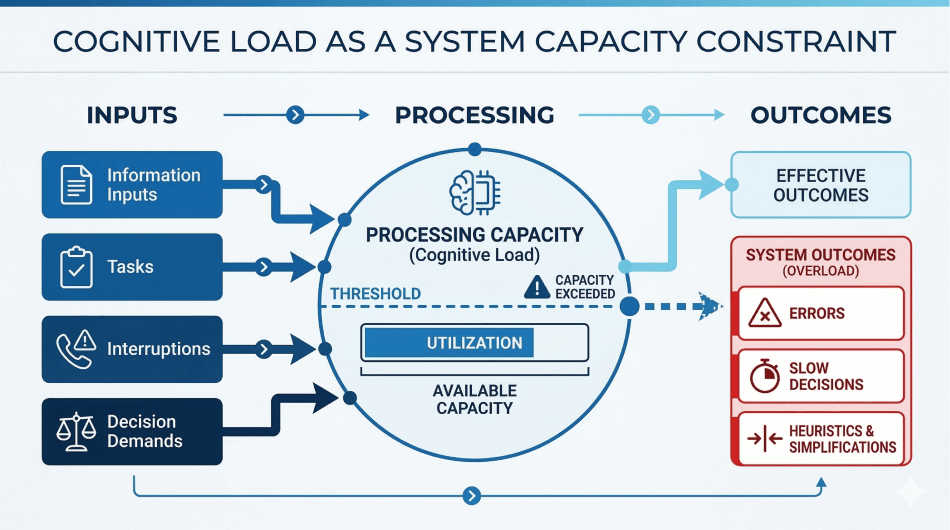
Every decision system operates within a finite processing capacity.
In human systems, this constraint appears as cognitive load — the total amount of information, decisions, signals, and interactions a mind must process at any given moment.
Cognitive load increases when:
- the number of inputs increases
- the complexity of those inputs increases
- the speed of required responses increases
- the number of simultaneous tasks increases
As cognitive load approaches the system’s processing limit, system performance begins to degrade.
This degradation appears structurally as:
- slower decision cycles
- increased error rates
- reduced signal detection
- reliance on simplified heuristics
Importantly, cognitive load is not a psychological trait. It is a capacity constraint inherent to the system itself.
Every mind, team, and organization has a limit to how much complexity it can process simultaneously.
Structural Translation
In simple terms, cognitive load is the amount of “mental weight” your brain is carrying at one time.
If you try to hold too many things in your head at once — tasks, decisions, information, interruptions — your thinking starts to slow down. You miss details. You forget steps. Small decisions take longer.
This isn’t because you’re distracted or unmotivated.
It’s because your brain, like any system, has a processing limit.
When too much complexity enters the system at once, performance naturally drops.
Structural Implication
When organizations ignore cognitive load, they often misdiagnose the resulting problems.
Managers may assume people need more discipline, better time management, or stronger focus. But the real issue is structural: the system is delivering more complexity than the processing capacity can handle.
Common signs include:
- constant context switching
- overloaded meeting schedules
- unclear priorities
- fragmented workflows
- decision fatigue across teams
As cognitive load rises, people rely increasingly on shortcuts, assumptions, and simplified thinking. Important signals get missed, mistakes increase, and decision quality declines.
In other words, the system isn’t failing because people are weak. The system is failing because its complexity exceeds its processing capacity.
Leverage Insight
Cognitive load defines the capacity boundary of any thinking system.
The most effective systems do not try to increase raw mental effort. They reduce unnecessary complexity so the available capacity can focus on what matters.
This is why cognitive load sits at the center of the Cognitive Load pillar:
performance improves not by pushing harder, but by designing systems that respect capacity limits.