

A team launches a new initiative with strong planning, capable people, and clear goals. The system looks solid on paper. Roles are defined. Processes exist. The strategy makes sense.
But a few months later, things start to slip. Decisions take longer. Small mistakes appear. Meetings multiply. People feel constantly busy but progress slows.
Nothing obvious has changed about the plan itself. The structure still exists. The talent is still there.
What changed is the amount of pressure placed on the system.
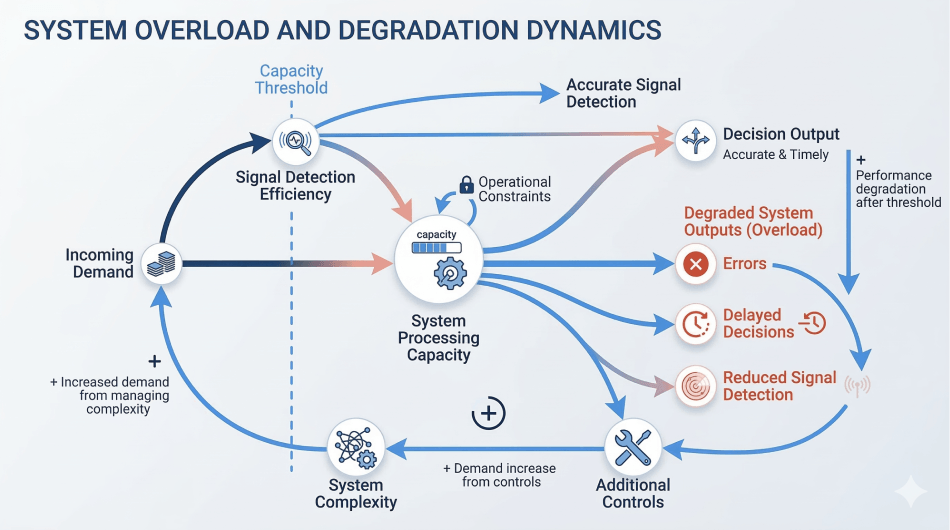
Systems Layer
All systems operate within capacity constraints.
Capacity defines the maximum volume of signals, tasks, decisions, and interactions that a system can process while maintaining stable performance.
When incoming demand approaches or exceeds system capacity, several structural shifts occur:
- processing delays increase
- signal discrimination weakens
- error probability rises
- feedback loops become unstable
This phenomenon is not limited to human cognition. It appears across many system types — communication networks, manufacturing lines, financial markets, and organizational structures.
As load exceeds capacity, systems shift from controlled processing to degraded processing modes.
In degraded modes, systems rely on simplified rules, incomplete information, or delayed responses. This allows the system to continue operating temporarily, but with lower stability and higher risk of cascading failure.
The key structural principle is simple:
When load exceeds capacity, system behavior changes.
Structural Translation
In simple terms, when too much demand is placed on a system, the quality of its output starts to drop.
For people and teams, this looks like:
- rushed decisions
- overlooked details
- miscommunication
- constant firefighting
Even if the underlying process is well designed, overload forces the system to operate in survival mode.
People stop thinking carefully and start reacting quickly. Tasks are completed faster but with more mistakes. Communication becomes shorter and less precise.
The system is still running, but it’s running in a degraded state.
Structural Implication
Organizations often try to solve these problems by improving processes or increasing accountability.
But if the underlying issue is capacity overload, those interventions rarely solve the real problem.
Instead, they often add even more cognitive demand:
- new reporting requirements
- additional approval layers
- more meetings
- extra monitoring
These responses increase the number of signals entering the system, which pushes cognitive load even higher.
The result is a reinforcing loop:
Overload leads to errors →
Errors trigger more controls →
Controls increase complexity →
Complexity increases overload.
Eventually the system becomes unstable, even though each individual change may appear reasonable in isolation.
Leverage Insight
System stability depends less on how well a process is designed and more on whether capacity limits are respected.
When load consistently exceeds capacity, even well-designed systems begin to break down.
Within the Cognitive Load pillar, the leverage point is clear:
The most stable systems are not the ones that demand the most effort —
they are the ones that manage complexity so demand stays within processing capacity.
