
Sometimes a task feels mentally demanding, but in a satisfying way.
You might be learning a new concept, solving a challenging problem, or connecting ideas that previously seemed unrelated. The thinking requires effort, but the effort leads somewhere. Afterward, the next similar task feels easier.
This type of effort is different from the frustration of navigating confusing instructions or switching between tasks. It feels focused rather than scattered.
That difference reflects a specific kind of cognitive load.
Systems Layer
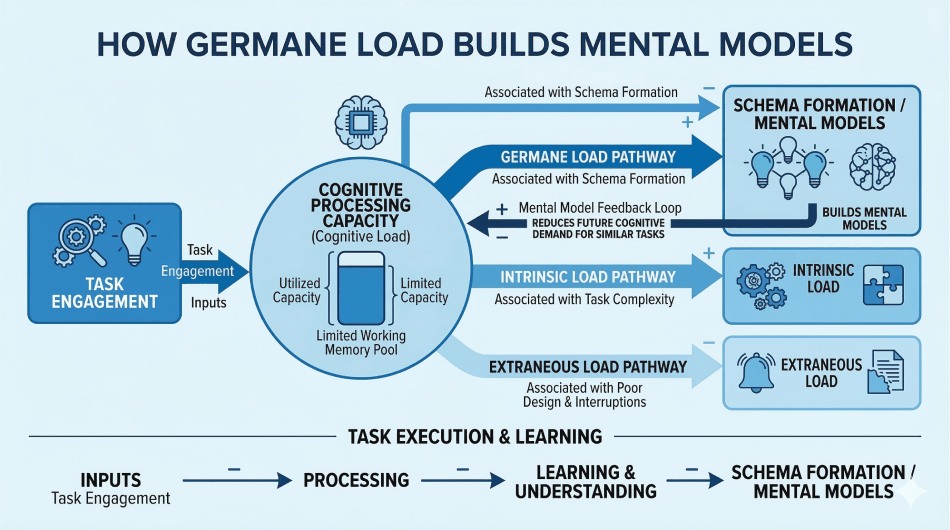
Germane load refers to the cognitive effort devoted to building and refining mental models.
In systems terms, germane load represents processing activity that strengthens the system’s internal representations of relationships, patterns, and structures.
When germane load is applied, the system forms schemas — organized knowledge structures that allow multiple elements to be processed as a single unit.
This restructuring reduces the number of elements that must be consciously processed in future situations.
For example:
- learning a formula creates a reusable structure
- understanding a workflow reduces future decision points
- recognizing patterns allows rapid interpretation of signals
Through schema formation, tasks that once required high cognitive effort become increasingly automatic.
In this way, germane load transforms short-term effort into long-term capacity.
Structural Translation
In simple terms, germane load is the mental effort that actually improves your understanding.
When your brain works to connect ideas, recognize patterns, or understand how something functions, it builds a mental structure that makes future thinking easier.
For example, the first time you learn a complex process, every step requires attention. But once you understand how the pieces fit together, the process becomes smoother and faster.
Your brain has built a model that compresses complexity.
That compression reduces the amount of thinking required the next time.
Structural Implication
The problem is that germane load competes with other types of cognitive load for the same limited capacity.
If intrinsic load is too high, the task may be too complex to understand.
If extraneous load is high, mental effort is wasted navigating the environment.
In both cases, the capacity available for germane load shrinks.
This is why people can work hard in a complex environment without actually improving their understanding. Their mental effort is consumed by task difficulty or system friction rather than by building useful models.
Over time, this prevents learning and slows skill development, even when people appear highly engaged.
Leverage Insight
Germane load represents productive cognitive investment.
The goal of effective system design is not to eliminate mental effort, but to protect the effort that strengthens understanding.
Within the Cognitive Load pillar, high-performing systems reduce extraneous complexity and manage intrinsic difficulty so cognitive capacity can focus on building mental models that improve future performance.
Learning occurs when effort transforms into structure.