
In many workplaces, the most capable people often become the most overloaded.
They understand complex systems quickly. They solve difficult problems. When something breaks, they are the ones others turn to for answers.
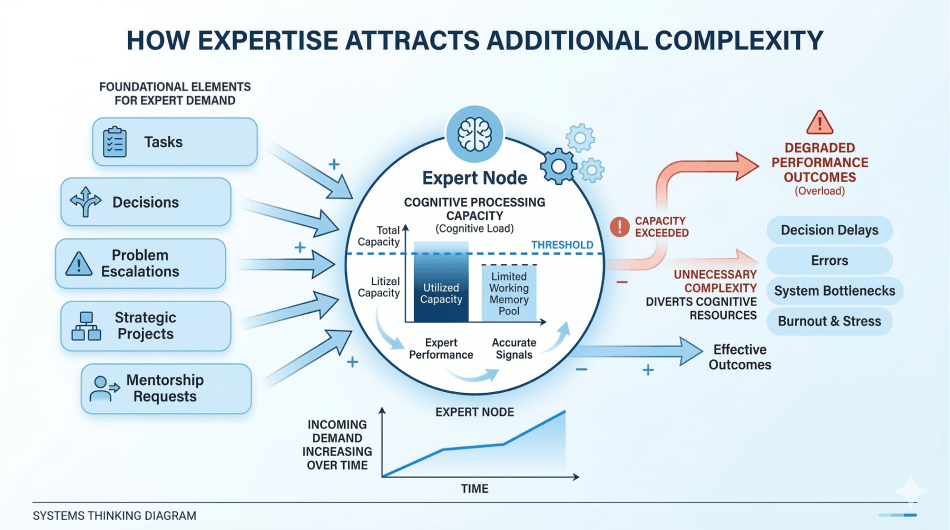
Over time, more decisions flow toward them. More projects require their input. More complexity passes through their desk.
Eventually, even the most capable professionals begin to feel the strain. Decisions slow down. Small details slip. The workload feels constantly full.
The problem isn’t a lack of intelligence.
It’s the structure of cognitive capacity.
Systems Layer
Cognitive systems operate under fixed processing constraints, regardless of individual expertise or intelligence.
While experience can improve efficiency through schema formation and pattern recognition, it does not remove the finite capacity of working memory — the system responsible for processing active information and decisions.
When the number of incoming signals exceeds this processing capacity, system behavior shifts toward overload conditions.
This occurs even in highly skilled individuals because:
- cognitive capacity remains finite
- incoming demand can scale without limit
- increased expertise often attracts additional complexity
Experts may process familiar patterns more efficiently, but novel problems, interruptions, and high decision volume still consume cognitive resources.
As demand continues to increase, the system eventually reaches the same structural boundary faced by all cognitive systems.
At that point, performance degradation becomes inevitable.
Structural Translation
In simple terms, being smart doesn’t give you unlimited mental capacity.
Experienced professionals can handle complex problems more efficiently because they recognize patterns and understand systems more deeply. But their brains still have limits.
If too many tasks, decisions, or interruptions arrive at once, those limits are reached just like they would be for anyone else.
In fact, highly capable people often experience overload sooner because they become responsible for more of the system’s complexity.
The better you are at solving problems, the more problems get routed to you.
Structural Implication
Organizations frequently misunderstand this dynamic.
High performers are often treated as if their capacity scales with their capability. As a result, more tasks, decisions, and responsibilities accumulate around them.
This creates structural bottlenecks where a large portion of the system’s decision flow depends on a small number of individuals.
As cognitive demand increases, these individuals experience overload:
- decision fatigue
- slower response cycles
- reduced attention to detail
- delayed problem resolution
The system becomes fragile because too much complexity is concentrated within a single processing node.
Ironically, the very people who stabilize the system can unintentionally become its largest constraint.
Leverage Insight
Intelligence improves efficiency, but it does not remove capacity limits.
Effective systems recognize that cognitive processing remains finite even for experts.
Within the Cognitive Load pillar, sustainable performance comes from distributing complexity across the system, rather than concentrating it within a few highly capable individuals.
Leverage appears when systems scale structure, not just talent.