

At the beginning of the day, decisions often feel easy.
You evaluate options clearly, weigh trade-offs, and choose a direction with confidence. But as the day progresses, even small decisions start to feel heavier.
Simple choices take longer. You might postpone decisions, default to familiar options, or select the quickest solution rather than the best one.
Nothing about the decisions themselves has changed. What has changed is the state of the system making them.
The mental resources used to evaluate choices are gradually being depleted.
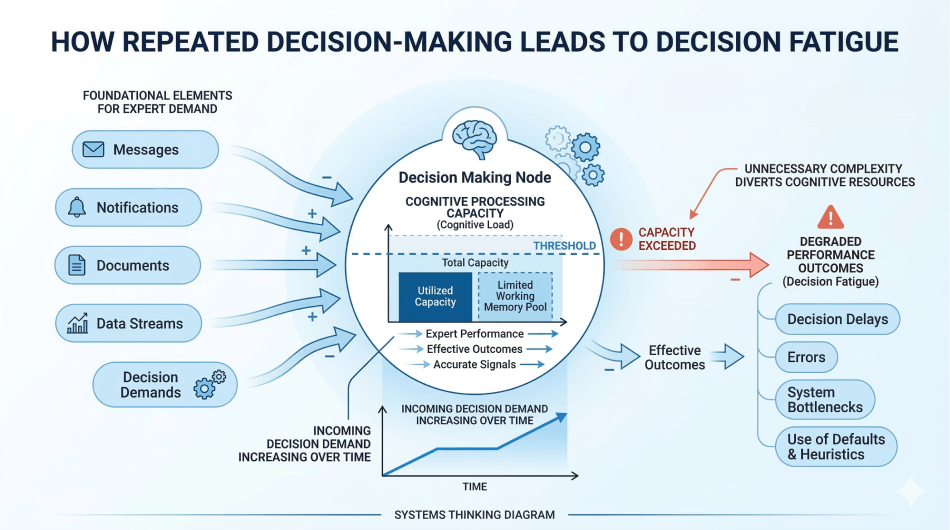
Systems Layer
Decision-making is a cognitive processing activity that consumes limited mental resources.
Each decision requires the system to:
- evaluate incoming information
- compare alternatives
- estimate consequences
- select a response
These operations draw from the system’s finite cognitive processing capacity.
When decision demand is repeated continuously over time, the available resources for careful evaluation begin to decline. This phenomenon is known as decision fatigue.
As cognitive resources are depleted, the system shifts toward lower-effort decision strategies such as:
- defaulting to existing choices
- delaying decisions
- selecting options that minimize immediate effort
- relying on simple heuristics
These strategies reduce cognitive effort in the short term but often decrease decision quality.
Decision fatigue is therefore not a motivational failure. It is a predictable consequence of sustained decision demand within a limited-capacity system.
Structural Translation
In simple terms, the more decisions you make, the harder it becomes to make good ones.
Each choice requires mental energy. After many decisions, your brain tries to conserve effort by simplifying how it chooses.
Instead of carefully comparing options, you may pick the default option, delay the decision, or go with whatever feels easiest.
This shift isn’t intentional. It’s the system protecting its remaining cognitive capacity.
Over time, this leads to lower-quality decisions even though the person making them is still capable.
Structural Implication
Modern work environments often generate far more decisions than cognitive systems are designed to handle.
Professionals frequently face:
- constant small operational choices
- frequent approval requests
- rapid message responses
- multiple project decisions in parallel
Individually, these decisions may appear trivial. Structurally, they accumulate.
As decision volume rises, cognitive resources are consumed earlier in the day. High-impact decisions may then occur when the system is already fatigued.
This creates a structural mismatch where the most important decisions are made when cognitive capacity is lowest.
The result is inconsistent judgment, slower responses, and increased reliance on default behaviors.
Leverage Insight
Decision fatigue reveals a key constraint in cognitive systems: decision volume matters as much as decision difficulty.
Effective systems reduce unnecessary decision demand by standardizing routine choices, clarifying rules, and structuring workflows.
Within the Cognitive Load pillar, the goal is not to eliminate decision-making but to reserve cognitive capacity for decisions that truly require human judgment.
When decision demand is managed, judgment remains stable across time.
