
In many workplaces, complexity grows gradually.
A new tool is added to improve communication. Another process is introduced to increase accountability. A few more dashboards appear to provide better visibility.
Each addition seems reasonable on its own.
But over time, people begin to feel stretched. Messages accumulate. Context switching becomes constant. Tasks overlap in ways that are difficult to manage.
When this happens, the common response is simple: people just need to handle more.
The assumption is that human mental capacity can expand to match the system.
Systems Layer
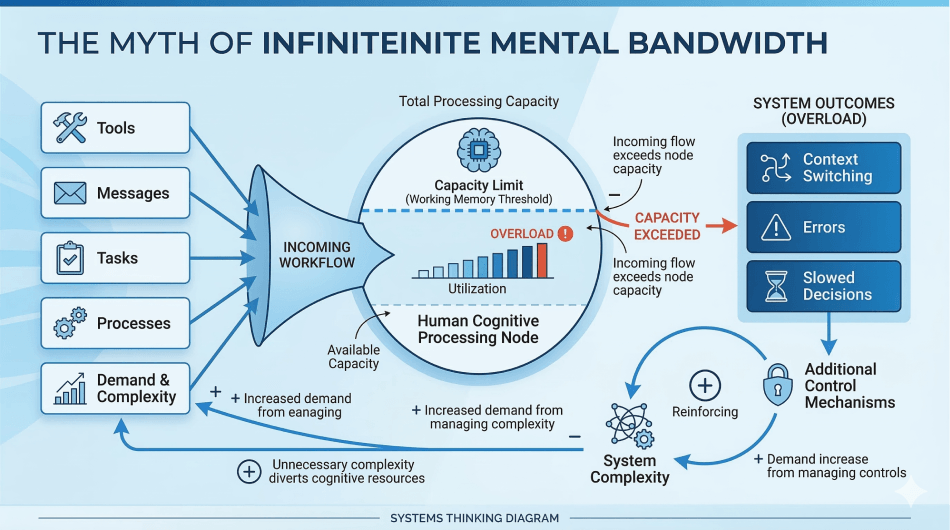
Many modern work systems operate under an implicit assumption of infinite cognitive bandwidth — the belief that individuals can continuously absorb increasing complexity without structural limits.
However, cognitive systems operate under strict processing constraints.
Human cognition relies heavily on working memory, the system responsible for holding and manipulating active information. Working memory capacity is limited in both volume and duration.
When multiple signals enter the system simultaneously — messages, decisions, instructions, and context shifts — they compete for the same finite processing resources.
As complexity increases, the system experiences several predictable structural effects:
- increased context-switching costs
- reduced signal discrimination
- slower processing cycles
- higher error probability
Importantly, these effects occur even when individuals remain highly capable and motivated.
The constraint is not willingness or effort. It is the finite bandwidth of cognitive processing.
Structural Translation
In simple terms, people cannot endlessly absorb more complexity.
Your brain can only actively process a limited amount of information at one time. When too many tasks, messages, and decisions arrive together, the system becomes overloaded.
Even if you try to keep up, something eventually gives way:
- attention becomes fragmented
- tasks take longer to complete
- details are missed
- thinking becomes reactive rather than deliberate
The idea that people can simply “handle more” ignores the natural limits of how cognitive systems work.
Structural Implication
Organizations that assume unlimited mental bandwidth often respond to complexity by adding even more layers of structure.
Examples include:
- additional reporting requirements
- more communication channels
- increased monitoring or tracking systems
- expanding meeting schedules
These additions are typically designed to improve control or visibility. Structurally, however, they increase the number of signals entering the system.
The result is a compounding effect:
More complexity →
More cognitive load →
Reduced processing efficiency →
More control mechanisms →
Even greater complexity.
Over time, the system becomes difficult to navigate even though each individual component may appear rational.
Leverage Insight
Mental bandwidth is not infinitely scalable.
Effective systems recognize that human cognition has fixed processing limits and design workflows that respect those limits.
Within the Cognitive Load pillar, performance improves not by expecting people to absorb more complexity, but by structuring systems that filter, sequence, and simplify information before it reaches human decision-makers.
Capacity is protected when systems manage complexity upstream.