
You open a communication channel looking for an important update.
Instead, you find dozens of messages — status updates, side discussions, links, reactions, and notifications. Somewhere in the thread is the information you actually need, but finding it takes time.
You scroll, skim, and search through the conversation trying to locate the relevant signal.
The difficulty isn’t the lack of information.
It’s the overwhelming amount of it.
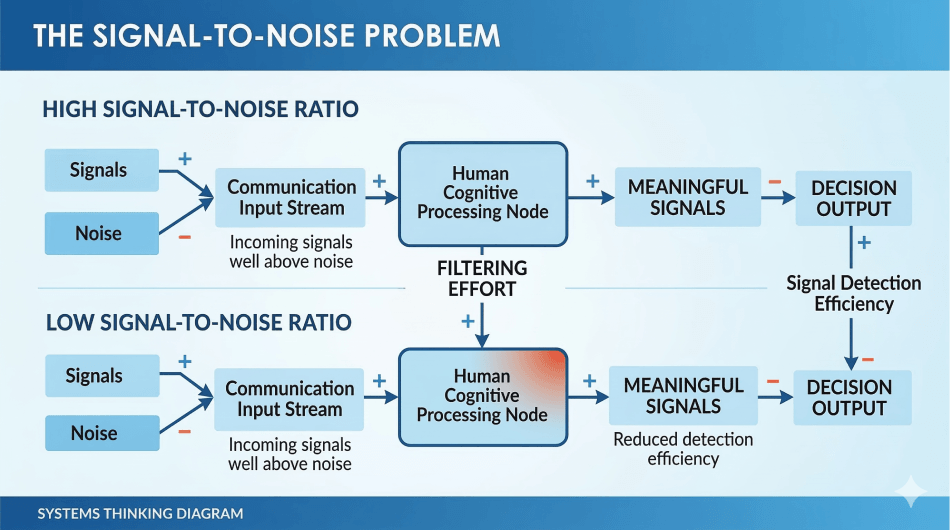
Systems Layer
In information systems, communication consists of two fundamental components:
- Signal — information relevant to a decision or action
- Noise — information that does not contribute directly to that purpose
The effectiveness of a communication system depends on its signal-to-noise ratio — the proportion of meaningful signals relative to irrelevant or low-value information.
When noise levels increase, the system must expend additional processing effort to detect meaningful signals.
For cognitive systems, this means additional effort spent on:
- filtering incoming information
- evaluating relevance
- scanning multiple sources for useful data
Since cognitive processing capacity is limited, increased noise consumes resources that would otherwise be used for interpretation, decision-making, or problem-solving.
As noise rises, signal detection becomes progressively more difficult, even when the signal itself remains present.
Structural Translation
In simple terms, the signal-to-noise problem occurs when important information is buried under too much other information.
Your brain must sort through everything to figure out what actually matters.
If there are too many messages, updates, or documents, the effort required just to find the relevant signal increases.
This creates a paradox: even though more information is available, clarity becomes harder to achieve.
The brain spends more time searching and less time understanding.
Structural Implication
Modern digital environments often increase noise faster than they increase signal.
Communication platforms make it easy to generate information continuously:
- frequent status updates
- ongoing message thread
- automated alerts
- multiple overlapping conversations
While each piece of information may appear harmless, the cumulative effect raises the noise level of the system.
As noise increases, individuals must invest more cognitive effort into filtering and scanning communication channels.
Eventually, important signals may be missed entirely, or detected too late to act on effectively.
The system produces abundant information but reduced clarity.
Leverage Insight
Improving system intelligence rarely requires adding more information.
Instead, it requires improving the signal-to-noise ratio.
Within the Cognitive Load pillar, effective systems protect cognitive capacity by filtering noise upstream so that decision-makers encounter fewer, clearer signals.
Clarity emerges not from information abundance, but from signal precision.