
You begin working on a problem that requires careful thought. After a few minutes, a message notification appears. You pause to respond. Then a calendar reminder pops up. Shortly after, another message arrives asking for quick input.
Each interruption seems small. Responding only takes a moment.
But when you return to the original task, something feels different. The thread of thought is gone. You need a few minutes to reconstruct where you were and what you were trying to solve.
Over the course of a day, these interruptions accumulate.
The result is a workday full of activity but very little sustained thinking.
Systems Layer
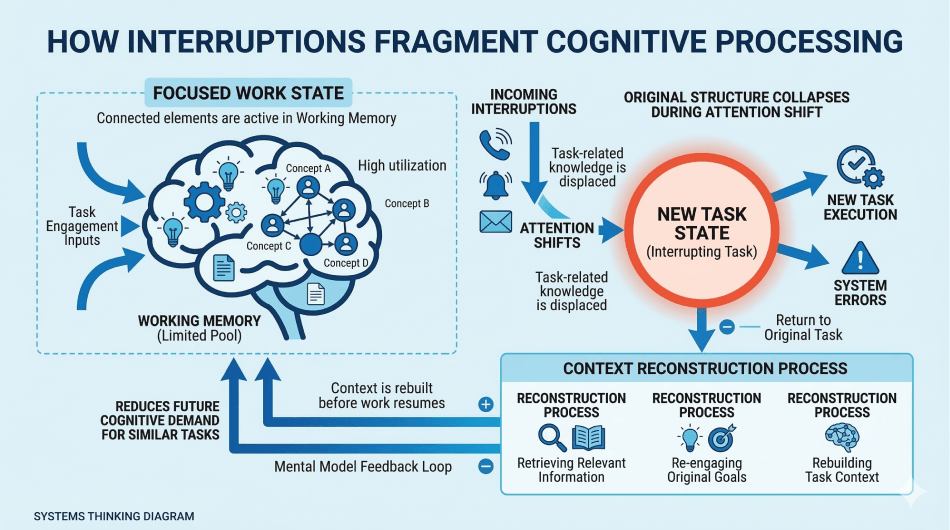
Attention operates as a sequential processing system. At any given moment, cognitive resources are focused on a limited set of active elements within working memory.
Deep thinking tasks — such as analysis, design, or complex problem solving — require sustained activation of multiple interacting elements over time.
Interruptions introduce new signals that force the system to shift its processing state.
Each interruption triggers several structural effects:
- the active working memory state is partially cleared
- context information must be stored or reconstructed
- cognitive resources are redirected toward the new signal
When the system later returns to the original task, the previously active structure must be rebuilt.
This reconstruction process consumes additional cognitive resources and time.
Frequent interruptions therefore fragment the continuity required for complex cognitive processing.
Structural Translation
In simple terms, interruptions break your thinking into pieces.
When you are focused on a complex task, your brain holds several ideas in working memory at the same time. These ideas connect together to form a mental structure.
When an interruption occurs, your attention shifts to something else. The structure you were holding in your mind begins to fade.
When you return to the task, you have to rebuild that structure before you can continue.
If interruptions happen frequently, your brain spends most of its time rebuilding context instead of moving forward.
Structural Implication
Modern communication systems dramatically increase the number of potential interruptions.
Notifications, chat messages, emails, alerts, and meeting requests all compete for immediate attention.
Because these signals appear urgent, they often override ongoing cognitive processes.
As interruptions increase:
- tasks take longer to complete
- deep thinking becomes rare
- cognitive fatigue rises
- decision quality declines
The system shifts toward short bursts of reactive activity rather than sustained reasoning.
Even highly capable professionals struggle to perform complex thinking when their attention is constantly fragmented.
Leverage Insight
Attention continuity is a structural requirement for deep thinking.
Within the Cognitive Load pillar, high-performing environments protect cognitive capacity by reducing interruption frequency and preserving uninterrupted thinking windows.
When attention remains stable long enough for ideas to connect, the system can sustain complex reasoning rather than constantly restarting it.