

Throughout most of human history, information arrived slowly.
Messages traveled at the speed of conversation, letters, or physical movement. News spread gradually. Decisions often had time to develop before new information appeared.
Today, information moves very differently.
Messages arrive instantly. Dashboards update continuously. Notifications appear throughout the day across multiple devices. Data streams from countless sources compete for attention.
The modern environment produces more information in a single day than earlier systems encountered in weeks or months.
Yet the human cognitive system has not changed at the same pace.
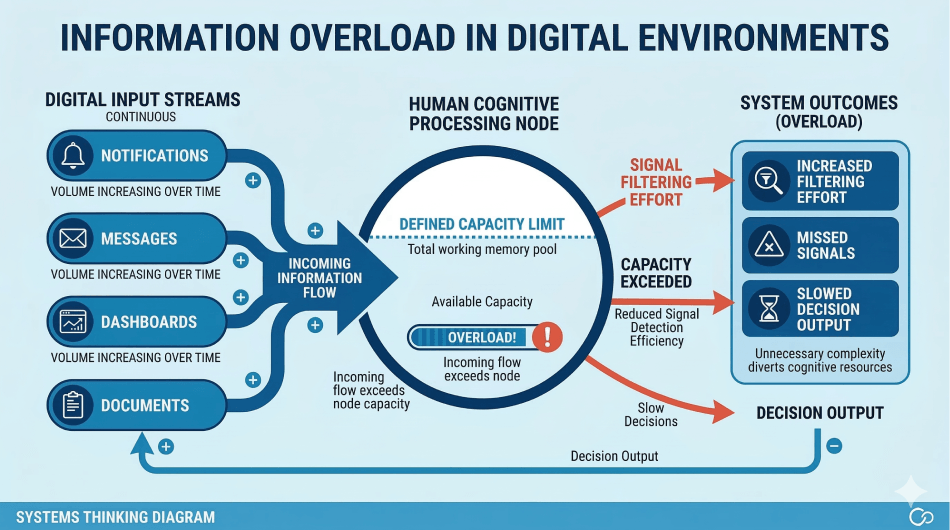
Systems Layer
Human cognition evolved within environments where information flow was limited, sequential, and relatively slow.
Under these conditions, cognitive systems could process incoming signals, form interpretations, and generate decisions without sustained saturation.
Digital environments have fundamentally altered the rate and volume of information production.
Modern systems generate continuous streams of:
- messages and notifications
- real-time data updates
- documents and knowledge resources
- collaborative communications
These streams dramatically increase the number of signals entering cognitive processing systems.
However, the processing capacity of working memory remains constant.
When information inflow exceeds processing capacity, cognitive systems experience overload conditions characterized by:
- reduced signal detection
- increased filtering effort
- slower interpretation cycles
- degraded decision quality
The challenge is not merely the quantity of information, but the velocity at which it arrives.
Structural Translation
In simple terms, our brains were designed for a slower information environment.
The human mind can process only a limited amount of information at one time. But modern digital systems deliver far more information than our cognitive systems can comfortably absorb.
Messages, updates, and alerts arrive continuously throughout the day.
As a result, the brain must constantly filter incoming information to decide what deserves attention.
This filtering process consumes mental energy, leaving less capacity for understanding, reasoning, and decision-making.
Structural Implication
Many organizations assume that increasing information availability will improve performance.
However, when information volume grows without structural filtering, the opposite effect can occur.
As data streams expand:
- individuals spend more time scanning information sources
- attention becomes fragmented across platforms
- decision-makers struggle to identify relevant signals
- cognitive fatigue rises from constant evaluation
The system becomes saturated with information but produces less clarity.
In extreme cases, individuals disengage from certain channels entirely simply to protect their remaining cognitive capacity.
Leverage Insight
Information abundance does not automatically increase system intelligence.
Effective systems manage information flow, not just information access.
Within the Cognitive Load pillar, the critical leverage point is designing environments where information is filtered, structured, and paced so that cognitive systems can process signals without becoming overwhelmed.
Clarity depends not on how much information exists, but on how much arrives at once.
