
You receive a task with a brief description: “Review this and make improvements.”
At first glance, it seems simple. But as you begin, questions start to appear.
What kind of improvements?
Who is the audience?
What constraints should guide the work?
What outcome defines success?
Instead of working on the task itself, much of your effort goes into interpreting what the task actually means.
The work hasn’t become harder because of its complexity. It has become harder because of ambiguity.
Systems Layer
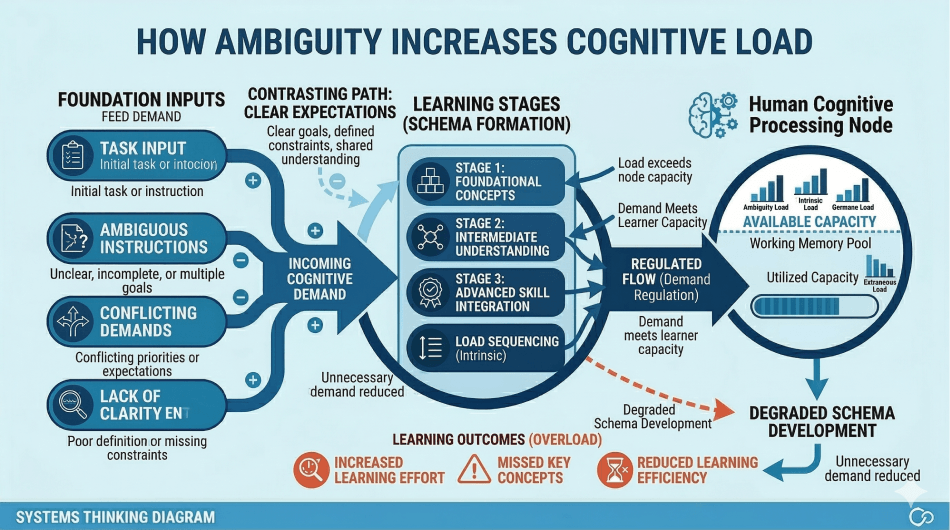
Ambiguity increases cognitive load by forcing the system to construct missing structure.
In structured environments, expectations, goals, and constraints are defined clearly. This allows cognitive processing to focus directly on task execution.
In ambiguous environments, however, the system must perform additional processing steps before meaningful work can begin.
These steps include:
- interpreting incomplete signals
- inferring goals and constraints
- evaluating multiple possible interpretations
- adjusting actions as new information emerges
Each of these processes consumes cognitive resources.
Because ambiguity multiplies the number of possible interpretations, it also increases decision complexity, requiring the system to consider more alternatives than necessary.
As ambiguity rises, cognitive effort shifts from solving the problem to interpreting the problem.
Structural Translation
In simple terms, unclear expectations make work mentally harder.
When instructions or goals are vague, your brain must fill in the gaps. You start asking questions internally:
What does success look like?
What exactly should I do?
Am I solving the right problem?
All of this thinking happens before the real work even begins.
The more uncertainty there is, the more mental energy is spent guessing, checking, and revising rather than actually completing the task.
Structural Implication
Ambiguity often appears harmless because it is less visible than obvious complexity.
But in organizations, unclear goals, roles, or expectations can dramatically increase cognitive demand.
Examples include:
- vague task descriptions
- undefined success criteria
- unclear ownership of responsibilities
- shifting priorities without clear signals
These conditions force individuals and teams to continuously interpret the environment.
The result is slower execution, repeated clarification cycles, and increased cognitive fatigue.
Ironically, work may appear flexible or adaptable while actually consuming large amounts of mental effort simply to maintain coordination.
Leverage Insight
Clarity reduces cognitive load.
Within the Cognitive Load pillar, one of the most powerful ways to preserve mental capacity is to define structure before work begins.
Clear expectations, goals, and boundaries allow cognitive systems to allocate effort toward solving problems rather than interpreting them.
Performance improves when the system removes uncertainty that does not contribute to the task itself.