
Leadership roles often appear to involve fewer operational tasks.
Instead of completing individual assignments, leaders spend much of their time in conversations, reviewing information, and making decisions that affect the broader system.
Yet many leaders describe their work as mentally exhausting. The challenge is rarely the difficulty of any single task.
The challenge is the constant need to process information from many directions at once.
Leadership changes not only the type of work being done, but also the cognitive structure of that work.
Systems Layer
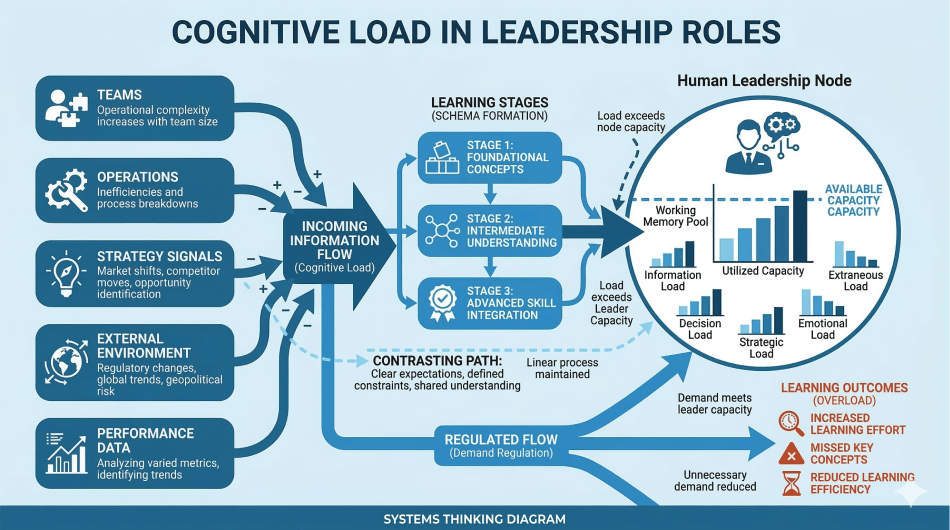
Leadership positions function as high-centrality nodes within organizational systems.
These nodes receive information from multiple parts of the system simultaneously, including:
- operational updates
- strategic signals
- performance indicators
- interpersonal dynamics
- external environmental changes
Each signal requires interpretation and integration with other signals in order to guide decisions.
Unlike specialized roles that focus on a narrower set of tasks, leadership roles must process cross-system interactions. Leaders must evaluate how changes in one part of the system influence outcomes in other areas.
This creates a form of cognitive demand characterized by:
- high signal diversity
- high decision consequence
- continuous context switching across domains
- long feedback loops between action and outcome
Because these signals converge on a limited number of decision nodes, leadership roles accumulate significant cognitive load.
Structural Translation
In simple terms, leaders must think about more parts of the system at the same time.
Instead of focusing on one task or project, they must consider how multiple teams, priorities, and external factors interact.
This means constantly shifting attention between different types of problems:
- operational issues
- long-term strategy
- team dynamics
- resource decisions
Each shift requires mental adjustment. Over time, the accumulation of signals creates significant mental load, even if each individual issue seems manageable.
Leadership work is mentally demanding not because of volume alone, but because of system-wide complexity.
Structural Implication
Organizations sometimes underestimate the cognitive demands placed on leadership roles.
Because leaders are expected to maintain visibility across the system, they often receive large volumes of information:
- detailed reports
- frequent meetings
- multiple communication channels
- escalating decisions from across teams
If these signals are not structured carefully, leaders may spend much of their cognitive capacity simply interpreting information flows.
This can lead to:
- delayed strategic thinking
- decision fatigue
- reactive rather than proactive leadership
- reduced clarity about long-term direction
When the cognitive load of system management grows too high, leaders struggle to maintain a coherent view of the organization.
Leverage Insight
Leadership effectiveness depends not only on capability but also on how the system structures information and decisions around leadership nodes.
Within the Cognitive Load pillar, high-performing organizations design systems that filter signals, distribute decision authority, and reduce unnecessary cognitive demand on leadership roles.
Leaders perform best when their cognitive capacity is reserved for interpreting meaningful system patterns rather than processing raw information.