

After an intense period of work — long meetings, difficult decisions, or sustained concentration — thinking often feels slower.
Ideas that were once clear become harder to hold in mind. Small decisions require more effort. Attention drifts more easily.
Many people assume this simply means they need to push harder or stay focused longer.
But cognitive systems do not function like machines that can operate continuously without pause.
They require periods of recovery in order to maintain stable performance.
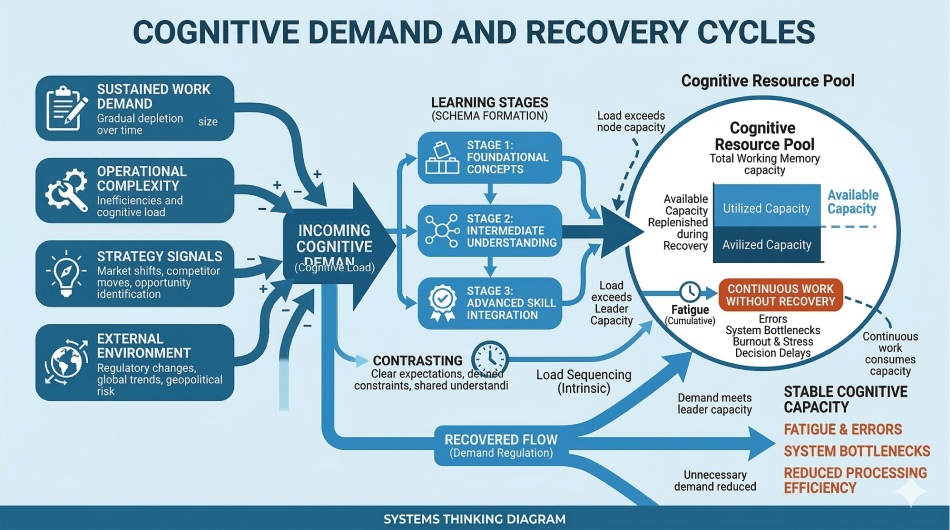
Systems Layer
Cognitive systems rely on limited processing resources that fluctuate over time.
Sustained cognitive activity consumes these resources through continuous operations such as:
- maintaining working memory structures
- evaluating incoming signals
- generating decisions and responses
- shifting attention between tasks
As these processes continue without interruption, cognitive resources gradually become depleted.
Without recovery periods, the system enters a degraded state characterized by:
- reduced processing efficiency
- increased cognitive fatigue
- slower decision cycles
- higher susceptibility to error
Recovery periods allow the system to restore these resources and re-stabilize processing capacity.
From a systems perspective, recovery functions as a stabilizing mechanism that prevents long-term degradation in performance.
Structural Translation
In simple terms, the brain needs time to recharge after intense thinking.
When you focus deeply or make many decisions, your mental resources are gradually used up. If you continue working without breaks, your thinking becomes slower and less accurate.
Recovery periods — such as stepping away from a task, resting, or shifting to less demanding activities — allow your brain to restore its capacity.
After recovery, attention becomes clearer and decisions become easier again.
These pauses are not lost time. They are part of how cognitive systems maintain stability.
Structural Implication
Many work environments unintentionally discourage recovery.
Continuous communication, dense schedules, and constant decision demands leave little space for mental restoration.
When recovery periods disappear:
- cognitive fatigue accumulates across the day
- complex thinking becomes harder to sustain
- decision quality gradually declines
- burnout risk increases over longer timeframes
Because the degradation occurs gradually, organizations may misinterpret the symptoms as motivation problems or performance issues.
In reality, the system is operating without the stabilizing function of recovery.
Leverage Insight
Cognitive recovery is not optional within high-demand environments.
It is a structural requirement for maintaining stable mental capacity over time.
Within the Cognitive Load pillar, sustainable performance emerges when systems include rhythms that alternate between cognitive demand and recovery.
Stability is achieved not by maximizing continuous effort, but by allowing the system to periodically restore its ability to think clearly.
