

Systems rarely collapse without warning.
Before a major failure occurs, smaller signals often begin to appear. Decisions take slightly longer than usual. Communication becomes less precise. Small mistakes start showing up in places where they normally would not.
Individually, these signals can seem minor. They are easy to dismiss as temporary stress, a busy week, or a difficult project.
But taken together, they often reveal something structural.
The system may be operating beyond its processing capacity.
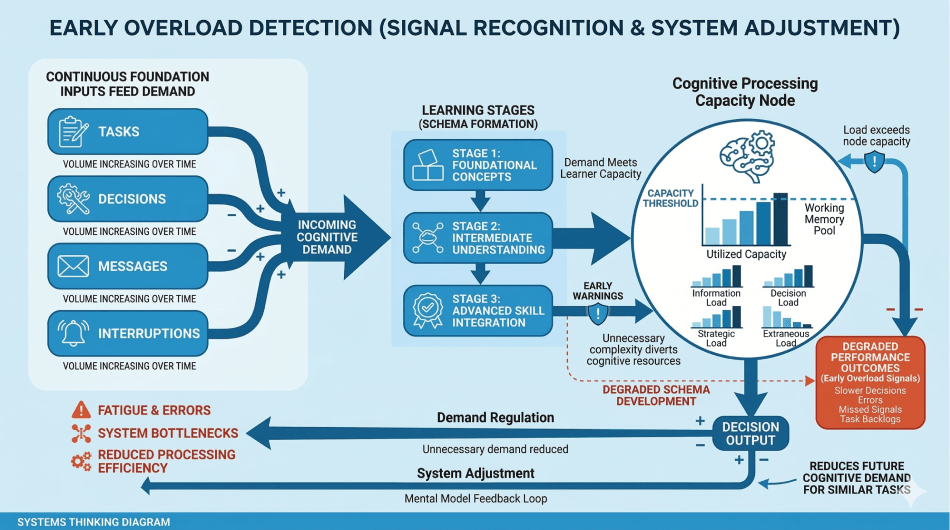
Systems Layer
Overload occurs when the incoming demand placed on a system exceeds its available processing capacity.
In cognitive systems, this demand includes tasks, decisions, information signals, and interruptions that must be interpreted and acted upon.
When demand begins to approach the system’s capacity limit, several predictable behavioral patterns emerge.
These patterns function as early warning indicators of overload:
- increased response times for decisions and communication
- rising error rates in routine tasks
- reduced signal detection or missed information
- increased reliance on simple heuristics or default choices
- growing task backlogs and delayed completion cycles
These changes occur because the system is reallocating limited resources to maintain operation under higher load conditions.
Rather than failing immediately, the system shifts into a degraded processing state where performance gradually declines.
Structural Translation
In simple terms, overload usually shows up through changes in behavior and performance.
When the brain or a team is handling more complexity than it can comfortably process, certain signs begin to appear:
- people take longer to respond or decide
- small mistakes happen more often
- important information gets overlooked
- decisions rely more on quick shortcuts
- unfinished work begins to pile up
These signals don’t necessarily mean people are less capable.
They usually mean the system is handling more cognitive demand than its capacity allows.
Structural Implication
Organizations often misinterpret early overload signals as individual performance problems.
Slower decisions may be attributed to hesitation. Errors may be blamed on lack of attention. Delays may be seen as poor time management.
In reality, these symptoms frequently arise from system-level capacity strain.
If the underlying load conditions remain unchanged, the signals intensify over time:
- delays become chronic
- mistakes increase in frequency
- cognitive fatigue spreads across the team
- decision quality deteriorates
Eventually, the system experiences more severe breakdowns such as missed deadlines, operational failures, or burnout.
Recognizing early signals allows systems to adjust before reaching these more costly outcomes.
Leverage Insight
Overload rarely appears suddenly.
It usually emerges through small performance signals that accumulate over time.
Within the Cognitive Load pillar, effective systems treat these signals as structural feedback rather than individual shortcomings.
When organizations respond early by adjusting demand, clarifying priorities, or redistributing load, they restore system stability before deeper failures occur.
Monitoring these signals protects both performance and human capacity.
