

AI tools are increasingly used to speed up work.
They summarize documents, generate drafts, analyze data, and suggest solutions in seconds. Tasks that once required long periods of manual effort can now be completed much faster.
At first, this seems like a clear reduction in workload.
But many people notice something unexpected. Even though the AI performs much of the task, the human still needs to review, verify, interpret, and guide the output.
The work does not disappear. It changes form.
Human-AI collaboration shifts cognitive load rather than eliminating it.
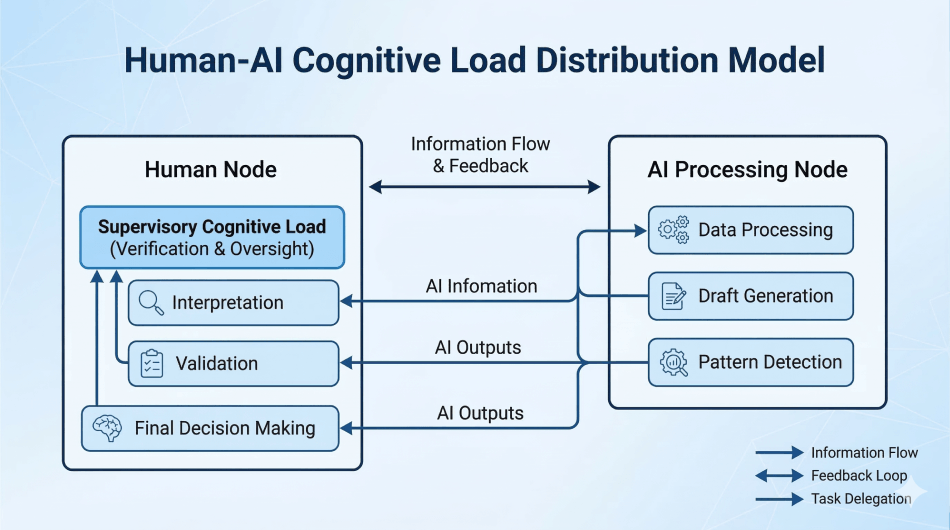
Systems Layer
Human-AI collaboration creates a hybrid cognitive system where processing tasks are distributed between algorithmic and human components.
AI systems are highly efficient at tasks such as:
- generating structured outputs
- scanning large volumes of data
- identifying patterns across datasets
- producing rapid drafts or suggestions
These capabilities can significantly reduce intrinsic task load, particularly for repetitive or computationally intensive work.
However, AI systems also introduce new forms of cognitive demand for human participants. These include:
- interpreting AI outputs
- validating correctness and reliability
- identifying subtle errors or hallucinations
- guiding the AI with appropriate prompts
- integrating AI results into broader decision contexts
This creates a supervisory cognitive load where the human acts as the system’s oversight and integration layer.
Rather than performing every step manually, the human now manages the interaction between automated outputs and real-world decision requirements.
Structural Translation
In simple terms, AI can reduce the amount of work people must do directly, but it often increases the amount of work required to check and guide the system.
For example, instead of writing a document from scratch, someone may review and edit an AI-generated draft.
Instead of analyzing raw data manually, they may evaluate AI-generated insights.
This saves time on some tasks, but it requires careful attention to ensure the results are accurate and useful.
The mental effort shifts from doing the work to supervising the work.
Structural Implication
Organizations sometimes assume that AI adoption will dramatically reduce cognitive load across a system.
In reality, the distribution of load changes.
If AI outputs are introduced without clear workflows, individuals may experience new forms of cognitive strain:
- reviewing large volumes of generated content
- deciding when AI outputs are trustworthy
- correcting subtle inaccuracies
- managing multiple AI tools simultaneously
These activities can create a supervisory bottleneck where humans must evaluate more information than before.
Without proper structure, the system may replace manual workload with evaluation overload.
Leverage Insight
Human-AI systems perform best when responsibilities are clearly structured.
Within the Cognitive Load pillar, the goal is not simply to automate tasks but to design collaboration structures that allocate cognitive effort appropriately between humans and machines.
AI should absorb repetitive processing while humans focus on interpretation, judgment, and system oversight.
When the division of cognitive labor is clear, the hybrid system reduces total mental strain while preserving human decision quality.
