

In many organizations, the same problems seem to return again and again.
A team misses deadlines. A new manager arrives and introduces new processes. For a short time things improve, but eventually the delays return.
In another environment, different people rotate through the same roles, yet similar patterns appear. Communication breaks down. Decisions slow down. Priorities collide.
At first glance, these situations seem to be about people — their choices, effort, or leadership style.
But when the same outcomes appear across different individuals, it raises a deeper question.
What if the system itself is shaping the behavior?
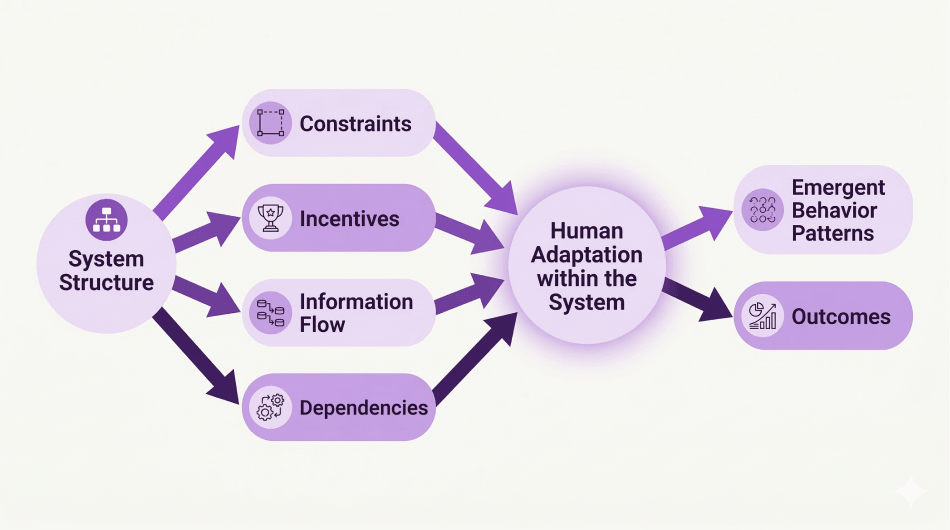
Systems Layer
In complex environments, system behavior often emerges from structural conditions rather than individual intentions.
A system’s behavior is shaped by several interacting elements:
- Structure — how roles, resources, and processes are arranged
- Constraints — limits that restrict available actions
- Incentives — signals that encourage certain behaviors over others
- Information flow — what information is visible, delayed, or missing
- Dependencies — how components rely on one another to function
These structural features create behavioral pressures within the system.
People inside the system adapt to these pressures in order to complete tasks, meet expectations, or manage constraints.
Over time, these adaptations produce consistent patterns of behavior.
Because the structure remains stable, similar outcomes continue to emerge even as individuals change.
The system does not instruct people exactly what to do.
But it strongly shapes what becomes practical, efficient, or necessary for participants inside it.
Structural Translation
In simple terms, people inside a system respond to the environment they are placed in.
If priorities are unclear, people make their own assumptions.
If decision authority is concentrated in one place, work waits for approval.
If teams depend on each other but lack coordination mechanisms, delays appear.
These outcomes may look like individual mistakes, but they often reflect structural conditions that guide behavior.
People are not simply acting based on intention.
They are reacting to the system they operate inside.
Structural Implication
When leaders interpret system behavior as purely a result of individual intention, they often intervene at the wrong level.
Typical responses include:
- asking people to work harder
- issuing reminders or policies
- replacing individuals in key roles
- increasing supervision
These actions may temporarily alter behavior, but they do not change the structural conditions producing the pattern.
As long as the system structure remains the same, similar outcomes will continue to appear.
This creates cycles where organizations repeatedly attempt to correct people instead of redesigning systems.
Leverage Insight
System behavior is rarely random.
It reflects the structure people are operating within.
When the structure changes, behavior patterns often change with it.
Understanding this principle allows leaders and teams to look for leverage in system design rather than individual correction.
Pillar: Systems Language — perception.
