
When a problem appears in an organization, the first response is often immediate and familiar.
Someone asks, “Who is responsible for this?”
A missed deadline, a failed launch, or a communication breakdown quickly becomes a search for the person who made the mistake. Meetings focus on decisions that were made, actions that were taken, and who should have done something differently.
This approach feels logical. After all, people make decisions.
But when similar problems keep appearing — even after people change roles or teams are reorganized — the explanation may lie somewhere else.
The issue may not be the individual. It may be the system they were operating inside.
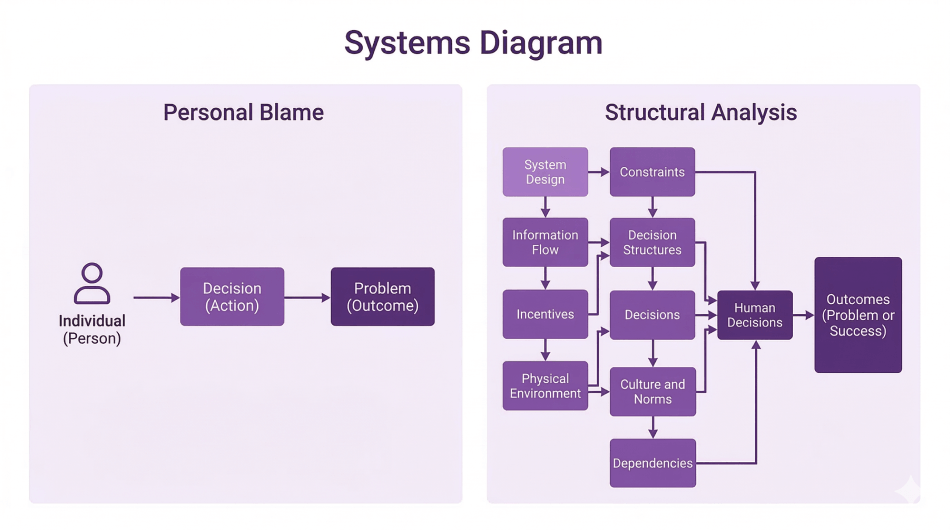
Systems Layer
In complex environments, outcomes often emerge from structural conditions rather than isolated individual decisions.
Systems Language examines how outcomes are shaped by:
- system design — how roles, responsibilities, and processes are arranged
- constraints — limits on time, resources, or authority
- information flows — what information is available, delayed, or hidden
- decision structures — where authority sits and how choices are made
- dependencies — how components rely on one another
These elements create the operating environment in which individuals make decisions.
Within that environment, certain behaviors become easier, faster, or more likely, while others become difficult or impractical.
When structural conditions consistently guide behavior in a particular direction, similar outcomes emerge regardless of who occupies the roles.
From a systems perspective, personal blame often describes the visible point of failure, but not the structural cause that produced it.
Structural Translation
In simple terms, Systems Language asks a different question.
Instead of asking:
“Who caused the problem?”
It asks:
“What in the system made this outcome likely?”
For example, if a decision leads to poor results, the structural explanation might examine:
- whether the person had complete information
- whether time constraints forced a rushed decision
- whether authority and responsibility were misaligned
- whether the system created conflicting incentives
The individual made the decision, but the system shaped the conditions in which that decision occurred.
Structural Implication
When organizations rely heavily on personal blame, they often miss opportunities to improve system design.
Typical responses include:
- replacing individuals
- increasing supervision
- issuing warnings or policies
- emphasizing accountability without structural change
These actions may address the immediate situation, but they leave the structural conditions unchanged.
As a result, new individuals enter the same system and encounter the same pressures, often producing similar outcomes.
Blame resolves responsibility.
Structure explains recurrence.
Leverage Insight
Blame focuses attention on individuals.
Systems Language redirects attention to system design.
When organizations shift from asking who failed to asking how the system produced the result, they gain access to structural leverage — the ability to change outcomes by redesigning the environment that shapes behavior.
Pillar: Systems Language — perception.